Two More Sea Guardians: ₹1,943-Crore Lease Buys the Navy Eyes Until the Predators Arrive
The Defence Ministry has signed a 30-month, ₹1,943 crore lease with General Atomics for two additional MQ-9B Sea Guardians — doubling the Navy's rented long-endurance surveillance fleet and bridging the gap until the 31 purchased Predators begin arriving from 2028.

Senapathi Desk
Staff reports & analysis
Published
3 min read
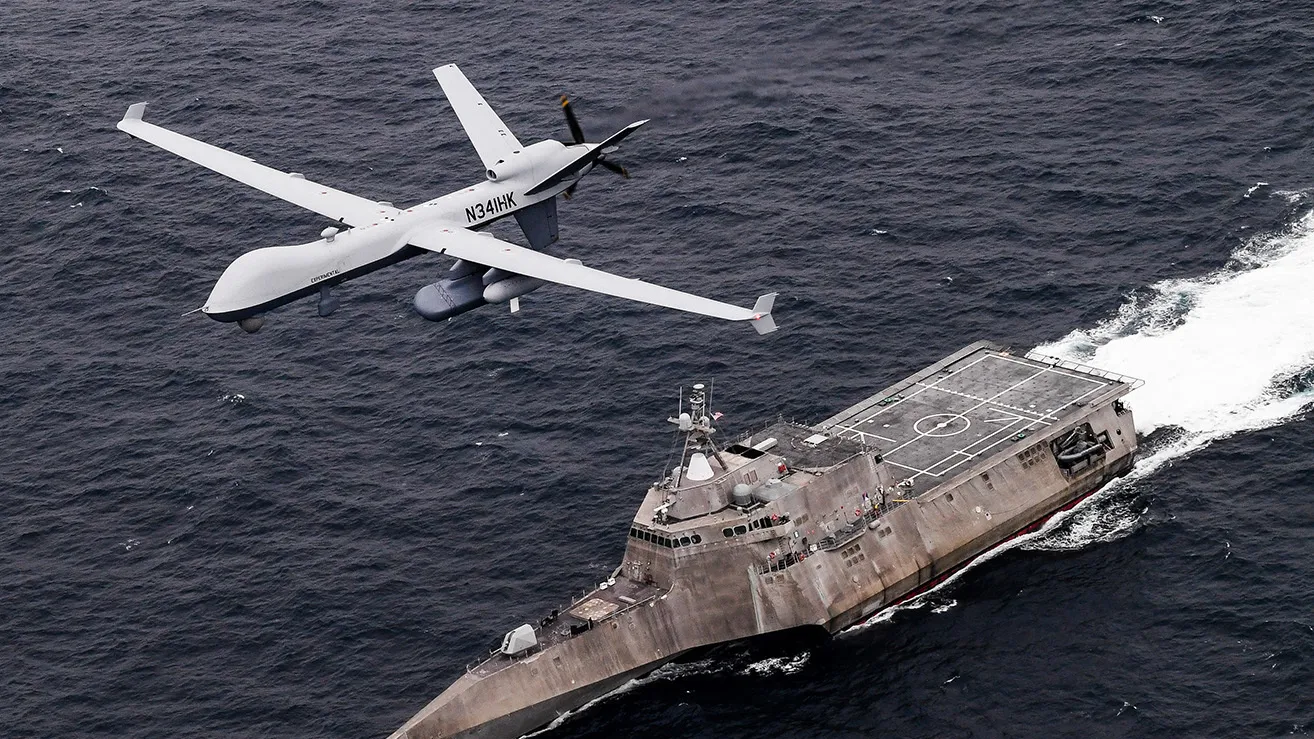
The Ministry of Defence signed a contract with General Atomics Aeronautical Systems on 17 August to lease two more MQ-9B Sea Guardian high-altitude long-endurance drones for the Indian Navy — a 30-month lease-and-operate arrangement valued at about ₹1,943 crore, signed at Kartavya Bhawan-2 in New Delhi in the presence of Additional Secretary and Director General (Acquisition) A. Anbarasu.
The ministry’s stated purpose is the familiar one: persistent intelligence, surveillance and reconnaissance over vast stretches of the maritime domain, strengthening the Navy’s ability to monitor and respond to developments across the Indian Ocean Region. The Sea Guardian is built for exactly that — an unarmed maritime variant of the Predator-B family that can stay aloft around 40 hours, feeding real-time imagery and sensor data back to its base while it loiters over sea lanes no manned aircraft can watch for that long.
From approval to contract in under eight months
This signing converts a decision the Defence Acquisition Council took on 29 December 2025, when it approved leasing two additional Sea Guardians within a larger package of acquisitions. Eight months from approval to signed contract is brisk by Indian procurement standards — and the reason is that this is the second time around. The Navy has operated a pair of leased Sea Guardians since late 2020, an arrangement extended repeatedly and tested in the hardest way: one of the aircraft went down in the Bay of Bengal in September 2024, and General Atomics replaced it under the lease terms. The model works, the infrastructure and crews exist, and doubling the fleet is an administrative act rather than an experiment.
The economics are worth stating plainly. ₹1,943 crore over 30 months works out to roughly ₹32 crore per aircraft per month — a figure that includes the operating support wrapped into the contract, not just the airframes. That is not cheap. It is what a navy pays when it needs surveillance hours now and the aircraft it has purchased are still years from delivery.
The bridge to the Predator fleet
Because that is what this lease really is: a bridge. In October 2024, India signed a roughly $4 billion Foreign Military Sales contract with the US government for 31 MQ-9B aircraft of its own — 15 Sea Guardians for the Navy and eight Sky Guardians each for the Army and Air Force, in the armed configuration the US and its allies fly. Deliveries are expected to begin from 2028 and run over four years, with General Atomics also committed to setting up maintenance, repair and overhaul facilities in India.
Run the two timelines side by side and the design of the lease becomes obvious. A 30-month clock starting now expires in early 2029 — almost exactly when the first purchased airframes are due on Indian ramps. The Navy is renting the capability through the gap, using an instrument the 2020 Defence Acquisition Procedure created for precisely this situation.
The demand signal underneath is the Indian Ocean itself. Chinese naval deployments, survey vessels and the dense commercial traffic of the region’s chokepoints have made persistent maritime domain awareness the Navy’s most consumable commodity — surveillance hours get used up daily, and satellites and P-8I sorties cannot cover everything continuously. Four leased Sea Guardians flying long orbits fill the space between satellite passes and manned patrols.
What to watch: how quickly the two new aircraft arrive and where they operate from; whether the leased fleet’s flying pattern shifts as the first armed MQ-9Bs approach delivery in 2028; and progress on the in-country MRO facilities, which will decide how much of this fleet’s sustainment India eventually controls. The lease is the stopgap; the test of the programme is what is standing when the stopgap ends.
Sources
- 1. PIB: MoD inks contract with General Atomics Aeronautical Systems for leasing of two MQ-9B Sea Guardian HALE RPAS for the Indian Navy — pib.gov.in
- 2. The Tribune: India leases two more MQ-9B Sea Guardian drones from US firm for Navy at Rs 1,943 crore — tribuneindia.com
- 3. Bharat Shakti: India signs Rs 1,943 crore drone lease deal with General Atomics — bharatshakti.in
Senapathi Desk
Staff reports & analysis
The Senapathi Report news desk. Original reporting and analysis synthesised from multiple corroborated sources — defence procurement, service developments and regional security, filed as it happens.