China's Drone-Carrier Type 076 Enters Final Trials — and India Has No Answer Yet
China's Type 076 Sichuan, the only amphibious assault ship fitted with an electromagnetic catapult, has entered its final test phase after a dead-load launch — a stealth-drone carrier class the Indian Navy currently has no equivalent to.

Senapathi Desk
Staff reports & analysis
Published
3 min read
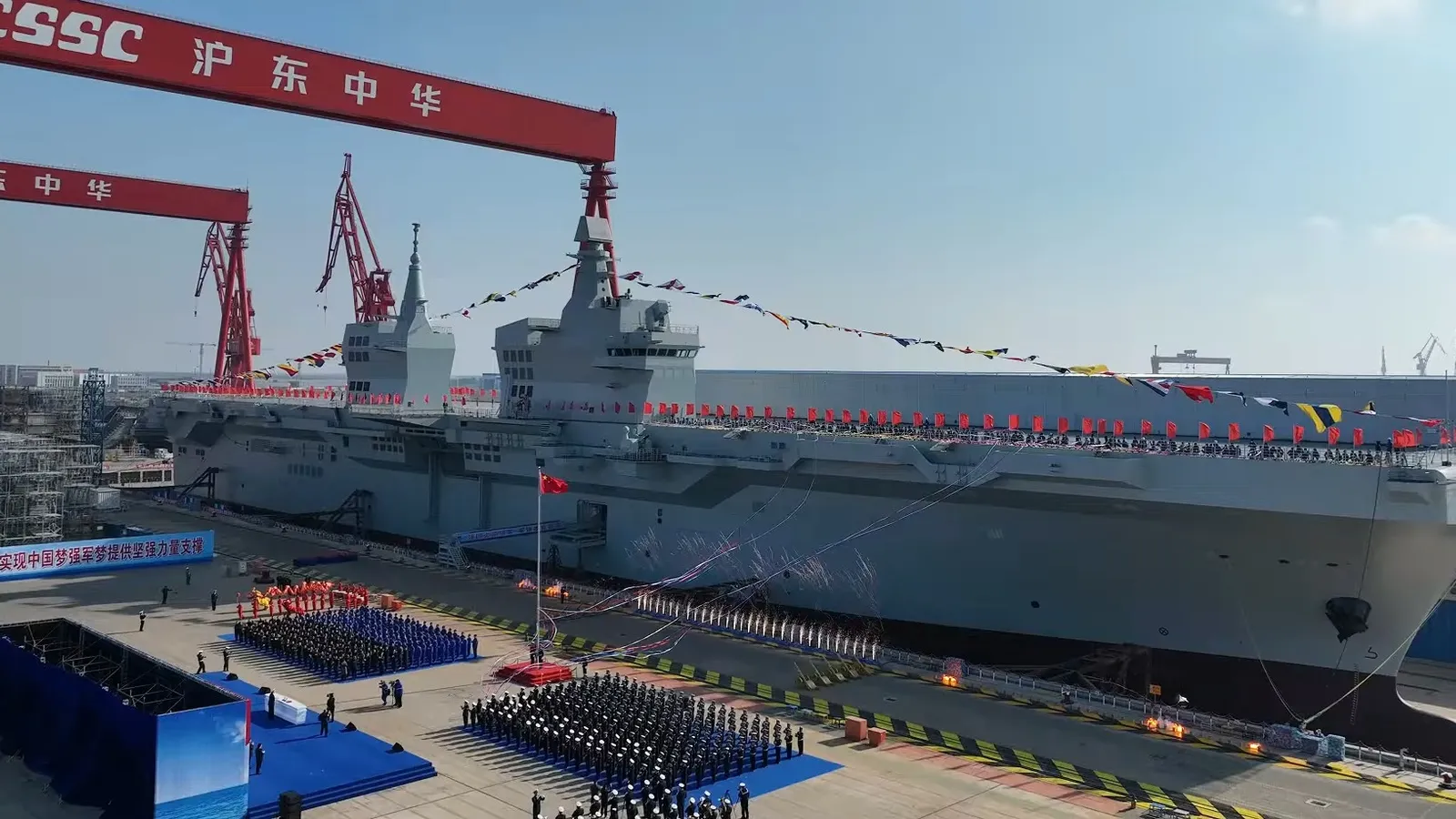
The clip lasts only seconds. A shuttle races down the bow of a broad grey warship, a weighted sled flies clear of the deck and drops into the sea — and with that, China has shown the world something no other navy possesses: an amphibious assault ship with a working electromagnetic catapult. The vessel is the Sichuan, lead ship of the Type 076 class, and the footage, released through Chinese state media in early August, is the first public confirmation that the ship’s most radical feature has moved from shipyard promise to hardware being proven afloat.
The release followed an announcement days earlier. On 29 July, China’s state broadcaster said the Sichuan had entered its “final testing phase”, with the electromagnetic catapult and arresting gear completed and the flight deck displaying its full set of line markings — the visual signature of a ship preparing for aviation trials rather than builder’s checks. Military commentator Wei Dongxu, speaking on the broadcast, presented the milestone as the last stretch before the ship joins the fleet; the claim is China’s own, but the physical evidence on the deck largely matches it.
The early-August footage went further. It showed the catapult hurling a dead load — the inert stand-in for an aircraft that every navy uses before risking real airframes on a new launch system — off the bow, the recognised preliminary step before actual aircraft launch trials. The same release showed a live-fire launch of the ship’s countermeasures, an indication that combat-systems testing is running in parallel with the aviation work rather than waiting behind it.
The ship itself blurs categories. Displacing more than 40,000 tonnes, with a full-length flight deck measuring 250 metres by 62 metres and an unusual twin-island superstructure, the Sichuan reads less like a traditional amphibious ship and more like a light aircraft carrier that happens to carry landing forces. Computer-generated imagery accompanying the state coverage made the intent explicit: a GJ-21 stealth attack drone — the naval variant of the GJ-11 flying wing — launching from the catapult, with five more of the type arrayed on deck. The animation is aspiration rather than achievement, but it states plainly what the catapult is for.
The tempo deserves as much attention as the technology. The Sichuan was launched in December 2024, began sea trials in November 2025, and has since completed several rounds of them — reaching the declared final phase within roughly twenty months of hitting the water. That is a schedule most navies would consider ambitious for a conventional amphibious ship, let alone a first-of-class vessel carrying an unproven launch system in a configuration nobody has attempted before. Expectations that the ship could be commissioned soon no longer look like propaganda.
For planners in India, the uncomfortable part is not the ship but the category it creates. A Type 076 is an expeditionary package: it can put marines and their equipment ashore, and it can independently launch and recover fixed-wing stealth combat drones far from home waters. China’s navy already operates in the Indian Ocean; a class built explicitly for distant contingencies, carrying catapult-launched strike drones, is the kind of platform that changes what a deployment there means.
India has nothing in this category, and nothing on a slipway that will change that. Its two aircraft carriers launch fighters off ski-jumps; no Indian warship of any type has a catapult, electromagnetic or otherwise. The navy’s amphibious flagship is a half-century-old dock landing ship bought second-hand from the United States in 2007, and the long-running plan to build a class of landing platform docks has cycled through tenders for over a decade without a keel being laid. India’s stealth combat drone work, meanwhile, remains at the demonstrator stage, with no deck-capable variant in sight.
The Sichuan may never sail south in anger. But once it commissions, the world’s only drone-carrying amphibious assault ship will belong to the one navy whose Indian Ocean presence grows every year — and the answer to it, for now, exists nowhere in India’s order of battle.
Sources
- 1. Type 076 Sichuan in final tests of its drone catapult, state media says — scmp.com
- 2. 40,000-tonne Type 076 tests electromagnetic catapult ahead of commissioning — marineinsight.com
- 3. Footage shows Sichuan's dead-load catapult launch and live-fire trials — interestingengineering.com
Senapathi Desk
Staff reports & analysis
The Senapathi Report news desk. Original reporting and analysis synthesised from multiple corroborated sources — defence procurement, service developments and regional security, filed as it happens.