Antelope Reef: China's First New South China Sea Island in a Decade, Explained
Imagery shows a roughly 1,460-acre artificial island finished in eight months at Antelope Reef, with a runway taking shape that would give the PLA a second full-length Paracels airstrip astride sea lanes India's trade and navy use.

Senapathi Desk
Staff reports & analysis
Published
3 min read
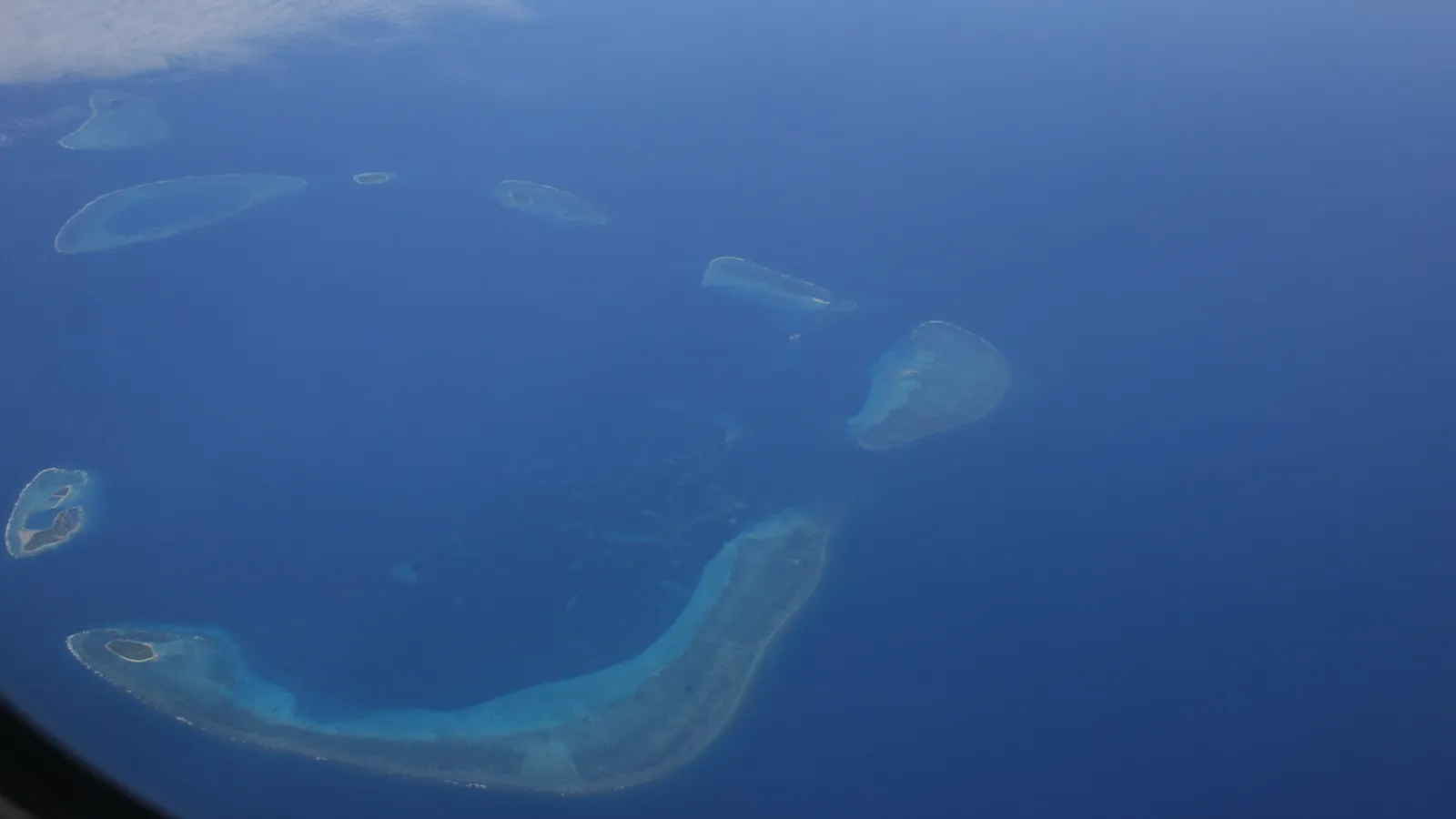
Eight months ago Antelope Reef was a ring of coral in the Crescent Group of the Paracel Islands, awash at high tide and of interest mainly to fishermen and the patrol craft that shadow them. In the latest satellite passes it is something else entirely: a hard-edged, flat-topped landmass of roughly 1,460 acres, with a dredged lagoon, piers, a helipad and the graded outline of a runway running down its length. The dredgers that built it have already sailed away. What they left behind is China’s first new island in the South China Sea in about a decade, and the speed of the work is as much the story as the island itself.
What the imagery shows
Analysts at a Washington-based maritime transparency initiative reported on 14 August that, eight months after dredging began, the finalised landmass at Antelope Reef measures 1,458 acres and that dredging and landfill are complete, with “no dredgers in sight in recent imagery”. A separate set of images published on 19 August put the figure at roughly 1,490 acres and described the first stage of construction as finished: an artificial island sitting on top of the reef, a lagoon dredged out for a large harbour, and piers, a helipad and buildings already in place. Construction is understood to have begun in late 2025.
The feature that matters most is the strip of earthworks now running 4,300 feet along the island. Its 180-foot width matches the runways China built at Fiery Cross, Subi and Mischief reefs in the Spratlys and at Woody Island in the Paracels, and the alignment is consistent with a runway that would eventually stretch to 10,000 feet. The 19 August assessment was slightly more conservative, putting the potential length at up to 9,000 feet. Either figure is enough for fighters, maritime patrol aircraft and transports.
Around the runway, the supporting structure of an air base is emerging. Foundations measuring 200 by 200 feet, the footprint of large hangars, are visible, as are two temporary concrete plants. An administrative centre is taking shape on the island’s eastern tip. This is not a fishing outpost being tidied up; it is the ground plan of a military facility being poured in sequence.
Why the Paracels, and why now
The Paracels sit at the northern end of the South China Sea, between the coast of Vietnam and China’s Hainan island. Vietnam claims the group; China has held it since 1974. Until now, Woody Island has been the only full-length runway in the chain. A second one at Antelope Reef, in the Crescent Group to the south-west, would push Chinese air coverage further over the sea lanes that run up the Vietnamese coast and thicken the web of bases that already stretches from Hainan to the Spratlys.
For India, that web is not an abstraction. A large share of the country’s eastward trade, to Japan, South Korea and beyond, transits the South China Sea. The Indian Navy makes regular port calls in Vietnam and has deepened its defence relationship with the Philippines, including the delivery of BrahMos cruise missiles. Every deployment to those partners passes within reach of Chinese airfields, and Antelope Reef would add one more.
The island also fits a pattern of pressure elsewhere in the same fortnight. From 4 August, the China Coast Guard cutter 1306 has been patrolling the area where Japanese and Philippine maritime claims overlap, and on 14 August it was joined by the survey ship Xiang Yang Hong 3. The deployments followed China’s declaration that boundary-delimitation talks between Japan and the Philippines were “illegal, null, and void”. Building on one reef while contesting talks between two neighbours is a consistent message: China intends to shape the geography of the South China Sea rather than negotiate it.
What to watch
Three markers will tell whether Antelope Reef becomes a full air base or a hardened outpost. The first is whether the runway earthworks are extended toward the 10,000-foot mark, and how quickly they are paved. The second is whether the hangar foundations receive structures large enough for combat aircraft rather than helicopters. The third is the arrival of radar domes and sensor installations, the signature that turned the Spratly islands from reclaimed sand into surveillance nodes.
If the first eight months are any guide, the answers will not take long.
Sources
- 1. CSIS AMTI: Is a New Chinese Runway Taking Flight at Antelope Reef? — amti.csis.org
- 2. AEI China-Taiwan Update, 21 August 2026 — aei.org
- 3. Reuters: China completes first stage of work on disputed South China Sea reef, images show — reuters.com
- 4. CSIS AMTI: As Tokyo and Manila Talk Boundaries, Beijing Breaks Them — amti.csis.org
Senapathi Desk
Staff reports & analysis
The Senapathi Report news desk. Original reporting and analysis synthesised from multiple corroborated sources — defence procurement, service developments and regional security, filed as it happens.