US Hits About 100 IRGC Targets Around Hormuz as Iran Fires on US Bases in Four Countries
About 100 IRGC targets struck in one afternoon, 13 ballistic missiles at Jordan, 18 dead by Iran's own count: the heaviest US-Iran exchange since the June ceasefire puts Hormuz shipping and India's Gulf exposure back on watch.

Senapathi Desk
Staff reports & analysis
Published
3 min read
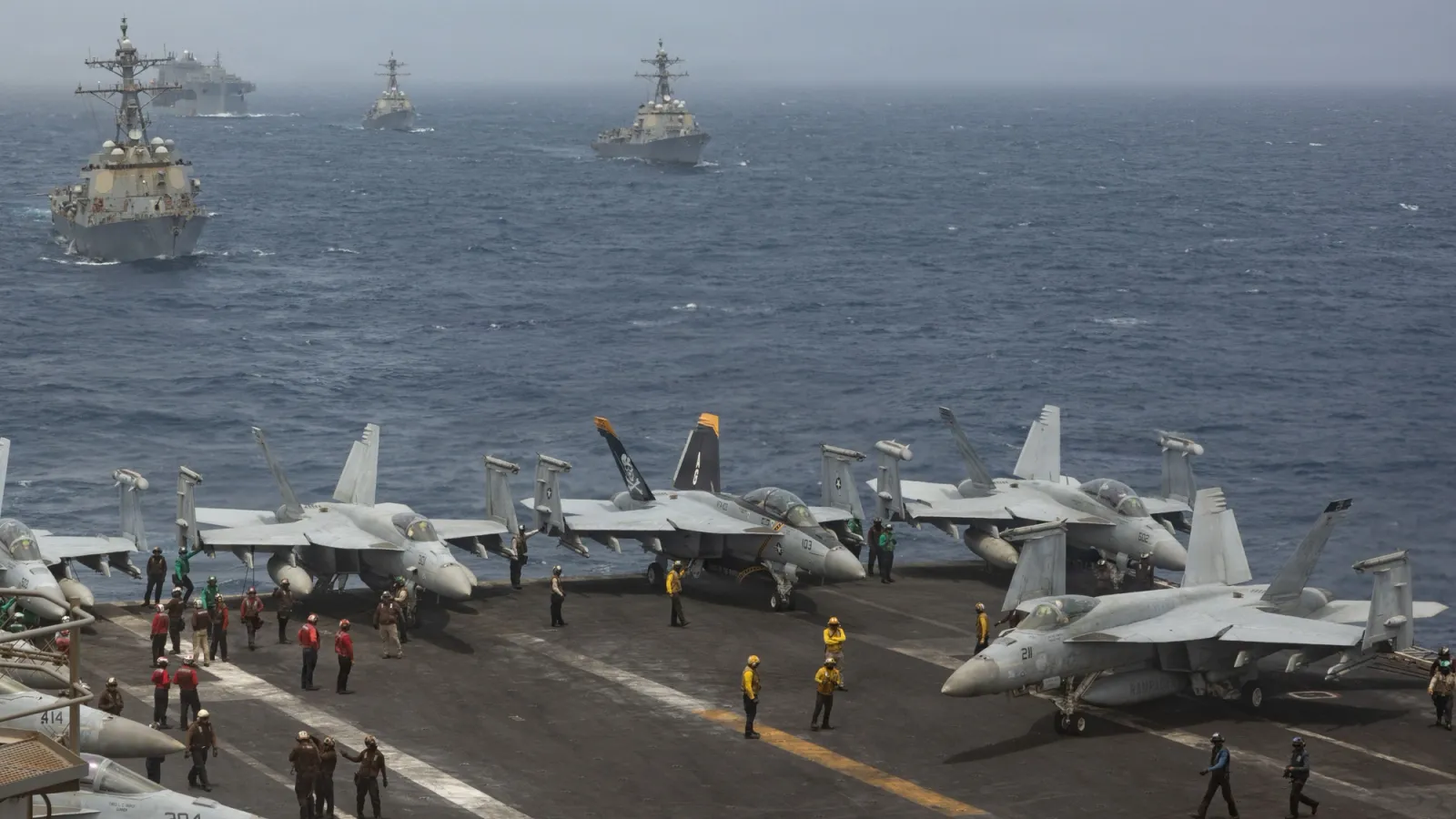
About 100 targets in a single afternoon. That is the scale of the American strike package that went into Iran on 1 September, the largest United States action against the Islamic Revolutionary Guard Corps since 29 July and the clearest sign yet that the June ceasefire is buckling.
The United States Central Command said its forces began striking IRGC targets at 12 p.m. Eastern time, listing air defence sites, radar systems, maritime assets and facilities, mine-laying capabilities and communications sites. It cited “recent attempted attacks by the IRGC against commercial shipping in the Strait of Hormuz and against American service members”, and noted that more than 50,000 US service members are currently operating across the Middle East. The command had already struck Iranian mine-launching systems on 30 August, a day before the main wave.
The trigger was a burst of Iranian attacks on merchant traffic. Across 30 and 31 August, three ships using the southern Hormuz route came under fire, among them the very large crude carrier Senegal Prosperity, which was hit by three projectiles. Independent tallies put the 1 September response at approximately 100 IRGC targets in and around the strait, and there are reports that Iranian oil tankers were among them under a new “tanker-for-tanker” policy: a hull for a hull.
Iran’s answer came overnight into 2 September. Jordan’s armed forces said their air defences engaged 13 ballistic missiles, intercepting 10, while three fell in remote areas without causing casualties. The IRGC claimed strikes on Camp Titin and Prince Hassan air base in Jordan, Sheikh Isa air base in Bahrain, US bases in Erbil in Iraq and installations in Kuwait. Kuwait and Bahrain both reported interceptions. US officials said no Americans were killed or wounded.
The casualty picture inside Iran rests, for now, on Iranian government figures. Iran’s health minister put the toll at 18 dead and 108 wounded. The largest single loss of civilian life is attributed to a strike on a telecommunications tower about 135 metres from a wedding venue in Kuhestak. Separately, four IRGC personnel are reported killed in Kermanshah and three members of the Basij militia on Lavan Island. None of these figures has been independently verified.
Diplomatically, the two sides are talking past each other. Iran’s president said his country would return to the June ceasefire if the United States was willing to abide by its terms. President Trump’s response was blunt: “an agreement with them isn’t worth the paper it’s written on”, and Iran would be hit “at a much harder and higher level” if it retaliated again. With missiles already fired at four countries, where that threshold now sits is anyone’s guess.
For India the exposure is threefold, and none of it is abstract. A large share of the country’s crude and gas imports transits the Strait of Hormuz, and a “tanker-for-tanker” logic in which both sides treat merchant hulls as legitimate targets is precisely the scenario Indian shipping lines and refiners have feared since the summer. Very large crude carriers of the kind struck in the run-up to the American action are the workhorses of the Gulf-to-India trade, and war-risk insurance tracks exactly this kind of week: three attacks in two days, followed by roughly 100 strikes, followed by 13 ballistic missiles.
The second exposure is human. A large Indian diaspora lives and works in Kuwait, Bahrain and the wider Gulf, and Iranian missiles were this week aimed at installations in at least two of those states. Interceptions held this time; the question for Indian missions in the region is what happens when they do not.
The third is strategic. India has spent the summer treating the June ceasefire, the Islamabad Memorandum, as the floor under Gulf energy flows. That floor was meant to take Hormuz off the target list. After the first days of September, it is back on it, and the two governments that signed the memorandum are publicly disputing whether it still means anything at all.
Sources
- 1. CENTCOM: US forces complete strikes on IRGC targets in Iran — centcom.mil
- 2. Critical Threats / ISW: Iran Update, 1 September 2026 — criticalthreats.org
- 3. Times of Israel liveblog, 1 September 2026: US strikes and tanker-for-tanker policy — timesofisrael.com
- 4. Gulf News: US strikes on Iran and Iranian retaliation against Kuwait, Bahrain and Jordan — gulfnews.com
Senapathi Desk
Staff reports & analysis
The Senapathi Report news desk. Original reporting and analysis synthesised from multiple corroborated sources — defence procurement, service developments and regional security, filed as it happens.