Makkah Pact Goes Operational: Pakistan Takes the Secretary-General's Chair in Istanbul
The first meeting of the Makkah pact's political-defence committee in Istanbul hands Pakistan the alliance's first secretary-general post, sites the secretariat in Saudi Arabia and opens joint-production tracks. India has yet to respond.

Senapathi Desk
Staff reports & analysis
Published
4 min read
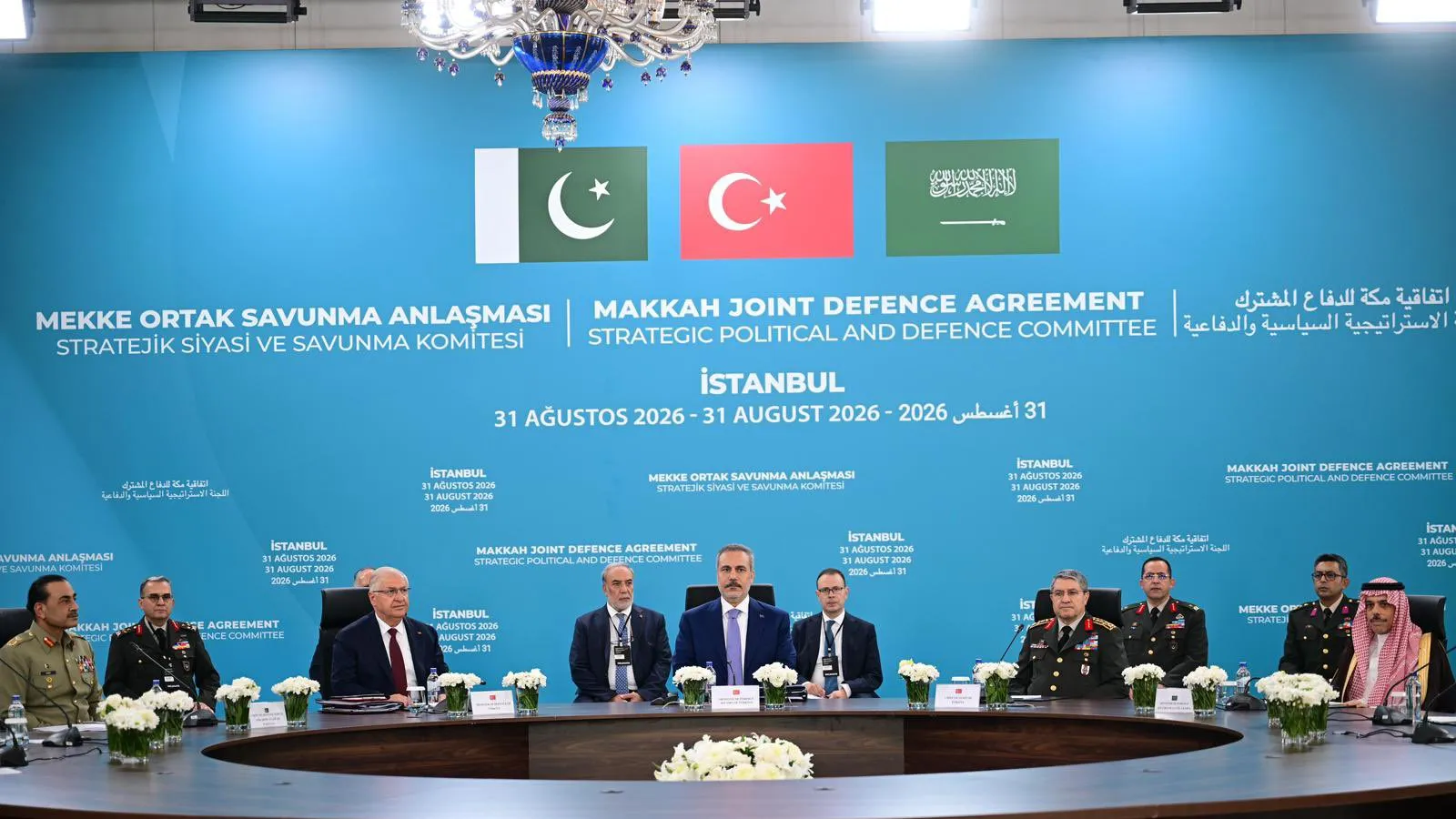
Twenty-four days. That is how long it took the Makkah Joint Defence Agreement to go from a signing ceremony to a working committee with ministers, generals and a division of labour — and for Pakistan to walk away holding the alliance’s first executive post. For India, the 31 August meeting in Istanbul is the moment the pact stopped being a sentence and started becoming an institution.
The sentence itself has not changed. Signed on 7 August in Makkah by the leaders of Saudi Arabia, Turkey and Pakistan, the agreement stipulates that an armed attack against any one of the three is to be regarded as an attack against all. What changed in Istanbul is that the three governments convened the body meant to give that clause hands and feet: the Strategic Political and Defence Committee, meeting for the first time, as recorded in an official notice from Turkey’s foreign ministry.
The guest list explains the seriousness. Each country sent its foreign minister, its defence minister and its uniformed chief — nine principals in one room. Pakistan fielded Deputy Prime Minister and Foreign Minister Ishaq Dar, Defence Minister Khawaja Asif and Field Marshal Asim Munir, who combines the posts of Chief of Defence Forces and army chief. Turkey sent Foreign Minister Hakan Fidan, Defence Minister Yasar Guler and Chief of General Staff General Selcuk Bayraktaroglu. Saudi Arabia was represented by Foreign Minister Prince Faisal bin Farhan, Defence Minister Prince Khalid bin Salman and Chief of General Staff General Fayyadh Al-Ruwaili. This was the political and military leadership of three states sitting down as a single committee, not a working-level consultation.
What they discussed, according to the Saudi-owned press account of the meeting, ran along four tracks: enhancing operational interoperability among the three armed forces; defence-industry cooperation, including joint production and research and development; joint counterterrorism; and the establishment of a secretariat framework together with a roadmap for future steps. Together those describe an alliance that intends to exercise, build and administer, not merely to declare.
The secretariat is where Istanbul produced its most concrete outcome, and it is the one India should read most carefully. Pakistani reporting of the meeting says Pakistan will provide the alliance’s first Secretary General for a three-year term, while the Secretariat itself will be established in Saudi Arabia. The division is telling. The money lives in Saudi Arabia; the first meeting was hosted by Turkey; the officer who runs the day-to-day machinery will be a Pakistani appointee. Of the three signatories, Pakistan is the one whose military planning is organised around a single, nuclear-armed neighbour — and it is Pakistan that has been handed the institutional lead for the pact’s formative years.
The defence-industry track deserves equal attention, precisely because it is the one most likely to produce something India can see. The same Pakistani account says the three sides committed to “robust defence industry cooperation, joint technology development and production”. No projects were named, no funding was disclosed and no timelines were published; those omissions matter. But the logic of the triangle is plain. Turkey brings an arms industry whose armed drones are its signature export and already fly in Pakistani colours. Saudi Arabia brings capital that neither partner can match. Pakistan brings a military with chronic resource pressures and a defined adversary. A joint-production framework is the mechanism by which the first two flow toward the third. Whether they do so at scale is the question the next few committee meetings will answer.
Munir’s own schedule in Istanbul reinforced the point. Beyond the committee, he met Prince Khalid bin Salman, Guler and Bayraktaroglu separately. Pakistan’s military media wing said “matters of mutual interest, bilateral defence cooperation and the regional security environment were discussed” — the standard formula, but one that put the Pakistani field marshal in direct bilateral channels with the Saudi defence minister and the Turkish military leadership on the day the trilateral machinery was switched on.
Much remains unbuilt. The committee’s roadmap has not been made public. Nothing announced in Istanbul creates a joint command, commits forces, or defines what the attack-on-one clause would actually oblige any member to do. Three countries with three different neighbourhoods will not read every crisis alike, and a secretariat cannot legislate that away. The pact remains, for now, an architecture rather than an army.
But architecture is what alliances are built from, and this one is going up faster than most. India said after the August signing that it was examining the pact’s implications. It has yet to respond to the Istanbul meeting. The implications are no longer hypothetical: a secretariat on Saudi soil, a Pakistani secretary-general, and a joint-production track that points, however indirectly, toward the forces on India’s western front.
Sources
- 1. Turkish foreign ministry notice on the first meeting of the Strategic Political and Defence Committee under the Makkah Joint Defence Agreement, Istanbul, 31 August 2026 — mfa.gov.tr
- 2. Express Tribune (Pakistan): Pakistan to provide first Secretary General of the Makkah alliance; secretariat to be set up in Saudi Arabia — tribune.com.pk
- 3. Saudi, Turkish and Pakistani ministers and chiefs hold first Makkah pact committee meeting in Istanbul — english.aawsat.com
- 4. Dawn (Pakistan): Field Marshal Munir and Ishaq Dar arrive in Turkey ahead of the first Makkah defence pact meeting — dawn.com
Senapathi Desk
Staff reports & analysis
The Senapathi Report news desk. Original reporting and analysis synthesised from multiple corroborated sources — defence procurement, service developments and regional security, filed as it happens.