Makkah Pact: Saudi-Turkey-Pakistan Defence Treaty Redraws India's Western Flank
The Makkah pact couples nuclear-armed Pakistan's military with Saudi finance and Turkey's NATO-grade defence industry. India is examining the implications. What the agreement does — and does not — commit its signatories to.

Senapathi Desk
Staff reports & analysis
Published
3 min read
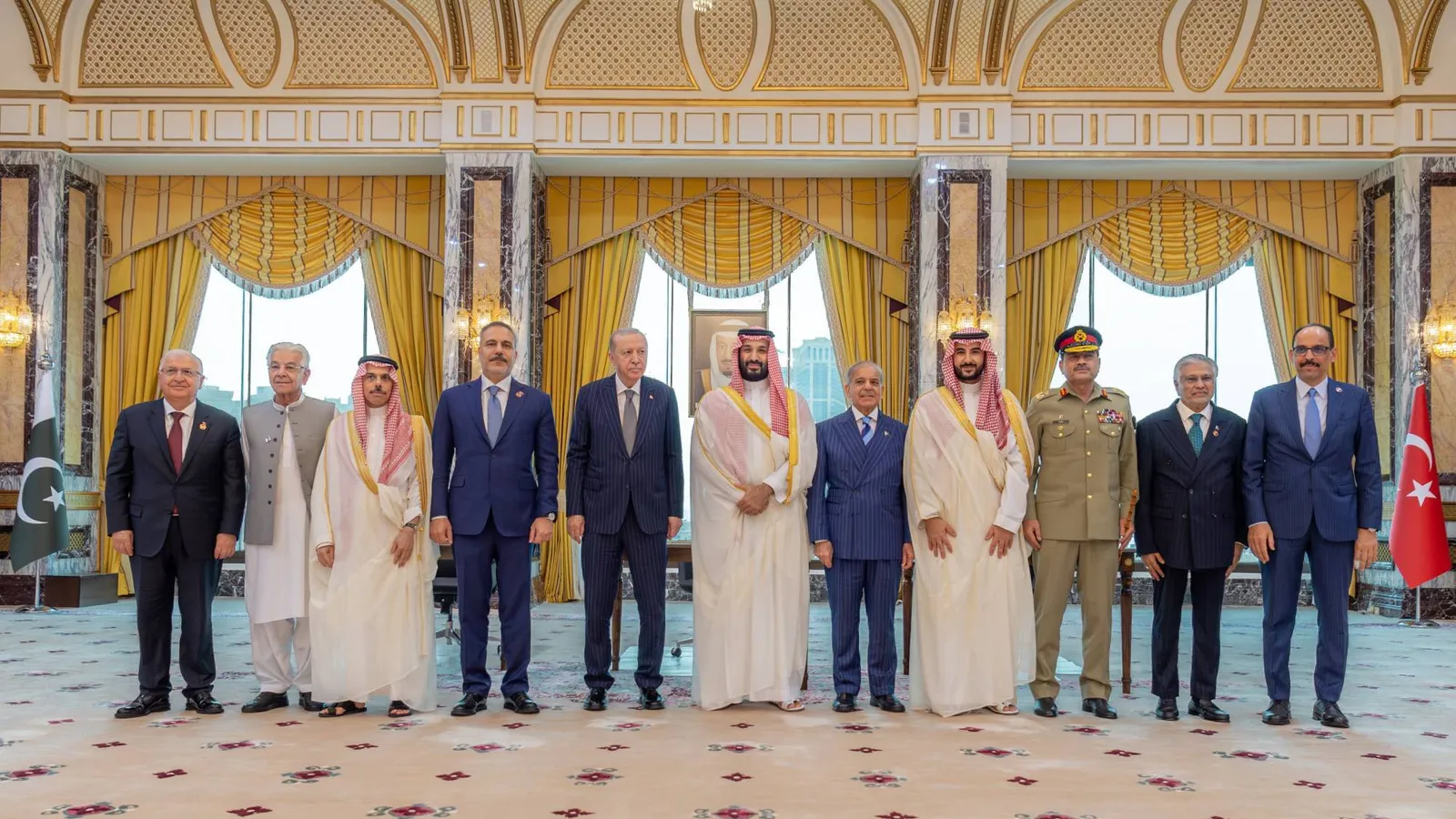
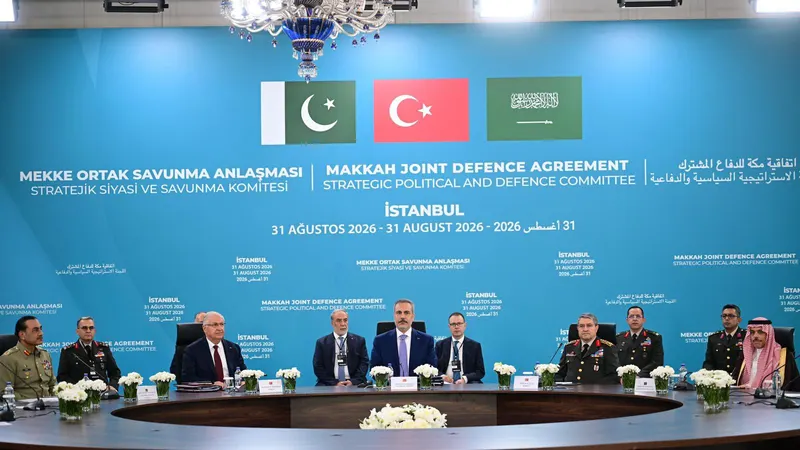
One sentence signed in Makkah on 7 August now belongs in every Indian threat assessment: “any armed attack against any one of the three states shall be regarded as an attack against them all.” With that clause, Saudi Crown Prince Mohammed bin Salman, Turkish President Recep Tayyip Erdogan and Pakistani Prime Minister Shehbaz Sharif bound their countries into a declared defensive bloc — the Makkah Joint Defence Agreement — and handed India a new strategic fact on its western flank.
The pact did not appear from nowhere. It builds directly on the Strategic Mutual Defence Agreement that Saudi Arabia and Pakistan signed in September 2025, which formalised what had long been an implicit security relationship between the two. The Makkah treaty trilateralises that bargain by adding Turkey. Pakistan’s foreign ministry described the agreement as reflecting the three states’ commitment to strengthening collective security — the sort of unremarkable language governments reach for precisely when the substance is anything but unremarkable.
The arithmetic explains the ambition, because each signatory supplies what the other two lack. Saudi Arabia brings money on a scale neither partner can match. Turkey brings a defence industry that has matured inside NATO standards into a serious arms exporter. Pakistan brings a large standing army and a nuclear arsenal. Analysts at the Atlantic Council put the logic plainly: the treaty adds “an economic giant and a nuclear power” to Turkey’s side, while for Pakistan it provides counterweights to India. That final phrase is the one that matters in Indian planning. Whatever else the pact was designed for, one of its purposes is India.
India’s public response has been deliberately spare. External affairs ministry spokesperson Randhir Jaiswal said on 11 August that the government was studying the treaty: “we are examining its implications, both from the perspective of our national security as well as considerations of regional stability, peace and stability.” India, he added, “will take all necessary measures” to safeguard its national interests. Measured words — but examining is not the same as unconcerned, and “all necessary measures” is not a phrase Indian spokespersons deploy casually.
So what, precisely, has been created? The honest answer is: less than the headline clause implies, and potentially more than its drafters can control. Collective-defence formulas of the attack-on-one variety are famously elastic; even the most institutionalised alliances leave each member to decide for itself what an attack obliges it to do. Nothing made public about the Makkah agreement specifies what response the clause triggers, who would command it, or what forces stand behind it. There is no published joint command, no declared basing arrangement, no stated nuclear dimension. A sentence is a posture, not a war plan, and the distance between the two is where this pact will be tested.
Yet India would be wrong to find too much comfort in that distance. Treaties create expectations, and expectations shape crises. In any future confrontation with India, Pakistan now enters the room holding a document in which an economic heavyweight and a NATO member assert that its defence is their own. Even if neither partner ever acts on the clause, its existence alters escalation arithmetic, promises relief for the chronic resource pressures on Pakistan’s military, and gives that military external patrons with a stated stake in its security. Deterrence lives in perception, and the perception this pact is built to create — that Pakistan no longer stands alone — costs its partners nothing until the day it costs them everything.
The pact’s weaknesses are equally real, and they are the familiar weaknesses of paper alliances. Three governments with three different neighbourhoods and three different sets of enemies will not read every crisis the same way. Saudi Arabia in particular has spent years cultivating an economic relationship with India that it would not lightly sacrifice, and alliance clauses tend to buckle exactly when honouring them becomes expensive. India’s counter is therefore not alarm but patience: deepen its own partnerships, keep its Gulf relationships in good repair, and let the gap between the treaty’s language and its members’ willingness do its quiet work.
But patience is not passivity. A commitment this explicit — joining Saudi finance, Turkish industry and Pakistani nuclear weapons in a single sentence — is the most significant realignment on India’s western horizon in years. India says it is examining the implications. The first implication is already clear: the western flank is no longer a line on the subcontinent’s map. It is a triangle, and all three of its corners now claim to answer as one.
Sources
- 1. India says it is examining implications of the Pakistan-Saudi-Turkey defence pact — aninews.in
- 2. Why Saudi Arabia, Pakistan and Turkey just signed a defence pact — atlanticcouncil.org
- 3. Pakistan foreign ministry statement on the Makkah Joint Defence Agreement — globalsecurity.org
- 4. Pakistan, Saudi Arabia and Turkiye sign the Makkah Joint Defence Agreement — quwa.org
Senapathi Desk
Staff reports & analysis
The Senapathi Report news desk. Original reporting and analysis synthesised from multiple corroborated sources — defence procurement, service developments and regional security, filed as it happens.