Why Pinaka's 60 km Test Matters More Than the Range Suggests
DRDO's 8 July Chandipur trial proved the Pinaka Long Range Guided Rocket at its 60 km minimum range — fired from an unmodified in-service launcher, handing Army rocket regiments a drop-in path to precision strikes out to 120 km.

Senapathi Desk
Staff reports & analysis
Published
3 min read
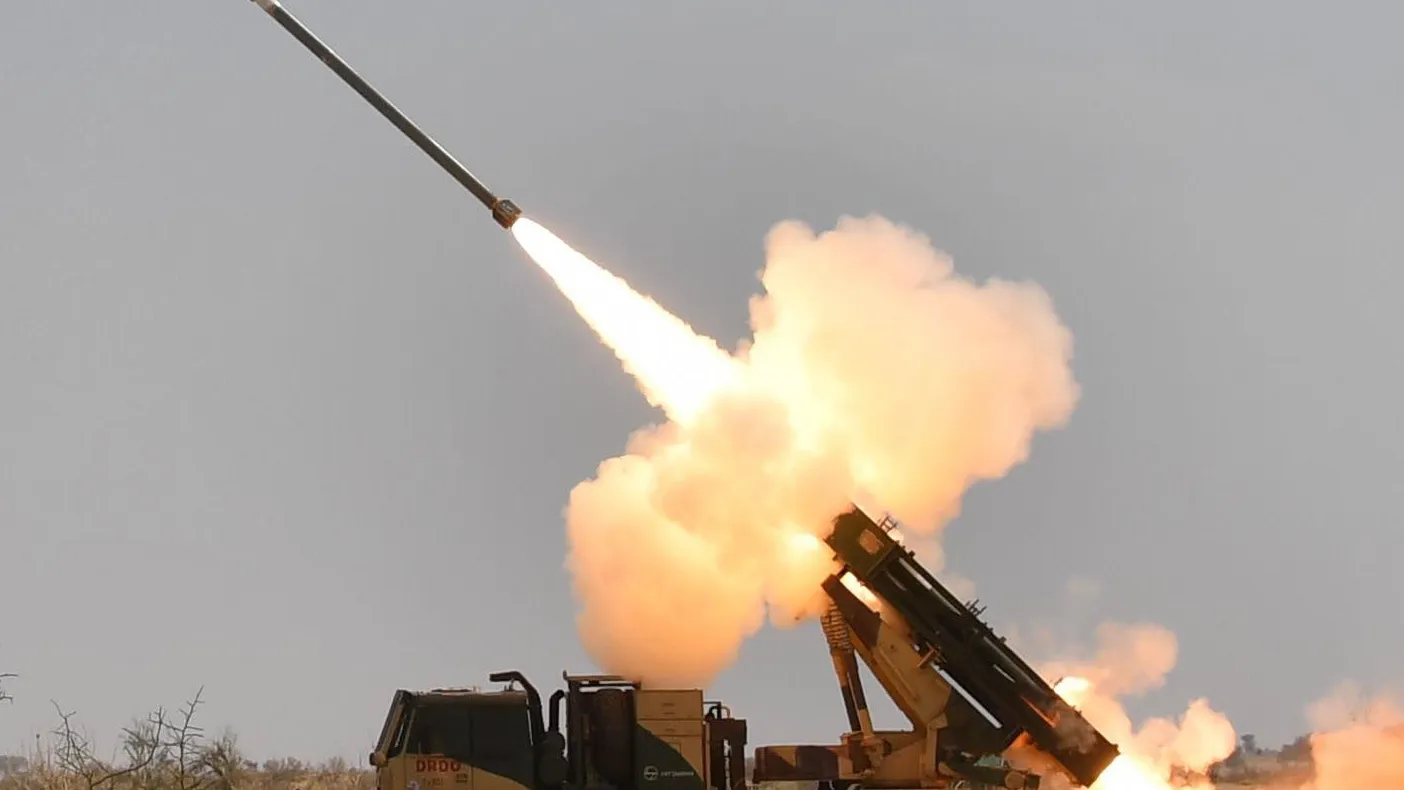
The most telling number from the 8 July flight test at the Integrated Test Range in Chandipur was not a record. A Pinaka Long Range Guided Rocket left the rails of a standard in-service launcher, flew 60 kilometres, and struck its target. In a testing culture that usually celebrates ever-longer reach, the Defence Research and Development Organisation had deliberately fired short — and that was the entire point of the exercise.
The trial, announced by the Ministry of Defence, put the LRGR through its user-defined minimum range of 60 kilometres. The rocket executed all planned in-flight manoeuvres and impacted the target with what the ministry called “textbook precision”, following the predicted trajectory exactly. For a weapon that Indian defence reporting says is designed to engage area targets anywhere from 60 to 120 kilometres away, the bottom of that envelope had just been formally closed.
The Hard End of the Envelope
Minimum range is the less glamorous boundary of a rocket’s performance, but it is not the easier one. A motor sized to push a guided rocket out to 120 kilometres arrives at a 60-kilometre target with energy to spare, and the guidance section has a compressed flight in which to manage it and still deliver a precise impact. That is why the ministry’s note that every planned manoeuvre was executed matters as much as the strike itself: the test validated the rocket’s ability to fly short on demand, not merely far.
It also changes what the LRGR is. A rocket proven only at maximum range is a demonstration; one certified across its full engagement envelope is artillery a commander can actually assign targets to. With the short-range point now flown, the LRGR’s advertised band — 60 to 120 kilometres, with warhead options reported to include pre-fragmented high explosive, penetration-cum-blast, thermobaric and cluster munitions — rests on test data at the end where the margins are tightest.
Ammunition, Not a New System
The second result from Chandipur may prove the more consequential. The LRGR flew from an in-service Pinaka launcher, demonstrating that Pinaka variants of different ranges can be fired from the same launcher without structural modification. For the Indian Army’s rocket regiments, that quietly converts a long-range precision weapon from a future acquisition programme into something closer to a new ammunition type.
The distinction is worth dwelling on. A deep-strike capability that demands new launch vehicles arrives with a procurement case, a production line, a training pipeline and a budget fight. One that drops into launchers already standing in regimental parks arrives as rockets in existing racks, fired by crews on equipment they already know. The 8 July test was, in that sense, as much a trial of the launcher’s flexibility as of the rocket’s guidance — and both passed.
The programme behind the weapon is spread across the DRDO map. The Armament Research and Development Establishment designed the rocket with the High Energy Materials Research Laboratory, supported by the Defence Research and Development Laboratory and Research Centre Imarat, while the trial itself was coordinated by the Integrated Test Range and the Proof and Experimental Establishment. Defence Minister Rajnath Singh congratulated DRDO, the Indian Army and industry, calling the test a major milestone for indigenous long-range guided rocket capability and a step toward self-reliance in advanced defence technologies.
What remains is the patient work of any weapons programme: more trials across the envelope, production and formal induction. But the test’s real message needs no waiting. Whenever the LRGR is ready for the Army’s regiments, the launchers that will fire it are already in service — which is why a 60-kilometre flight may end up mattering more than shots twice as long.
Sources
- 1. Ministry of Defence release on the Pinaka LRGR flight test — pib.gov.in
- 2. India conducts successful flight test of Pinaka Long Range Guided Rocket — tribuneindia.com
- 3. Why the Pinaka LRGR's minimum-range flight test matters — theweek.in
- 4. DRDO flight-tests Pinaka LRGR with 60 km minimum range — ddnews.gov.in
- 5. Mirror of the official Pinaka LRGR test announcement — globalsecurity.org
- 6. Pinaka long-range rocket hits target with textbook precision at 60 km — republicworld.com
Senapathi Desk
Staff reports & analysis
The Senapathi Report news desk. Original reporting and analysis synthesised from multiple corroborated sources — defence procurement, service developments and regional security, filed as it happens.