840 Drones in 12 Months: Army's ₹1,577-Crore Loiter-Munition Order Goes to Tata and NIBE
The ₹1,577 crore Fast Track order for 84 loiter-munition systems and 840 100-km munitions splits 64:36 between Tata Advanced Systems and NIBE, with delivery due inside 12 months — the first big strike-drone buy since Operation Sindoor.

Senapathi Desk
Staff reports & analysis
Published
3 min read
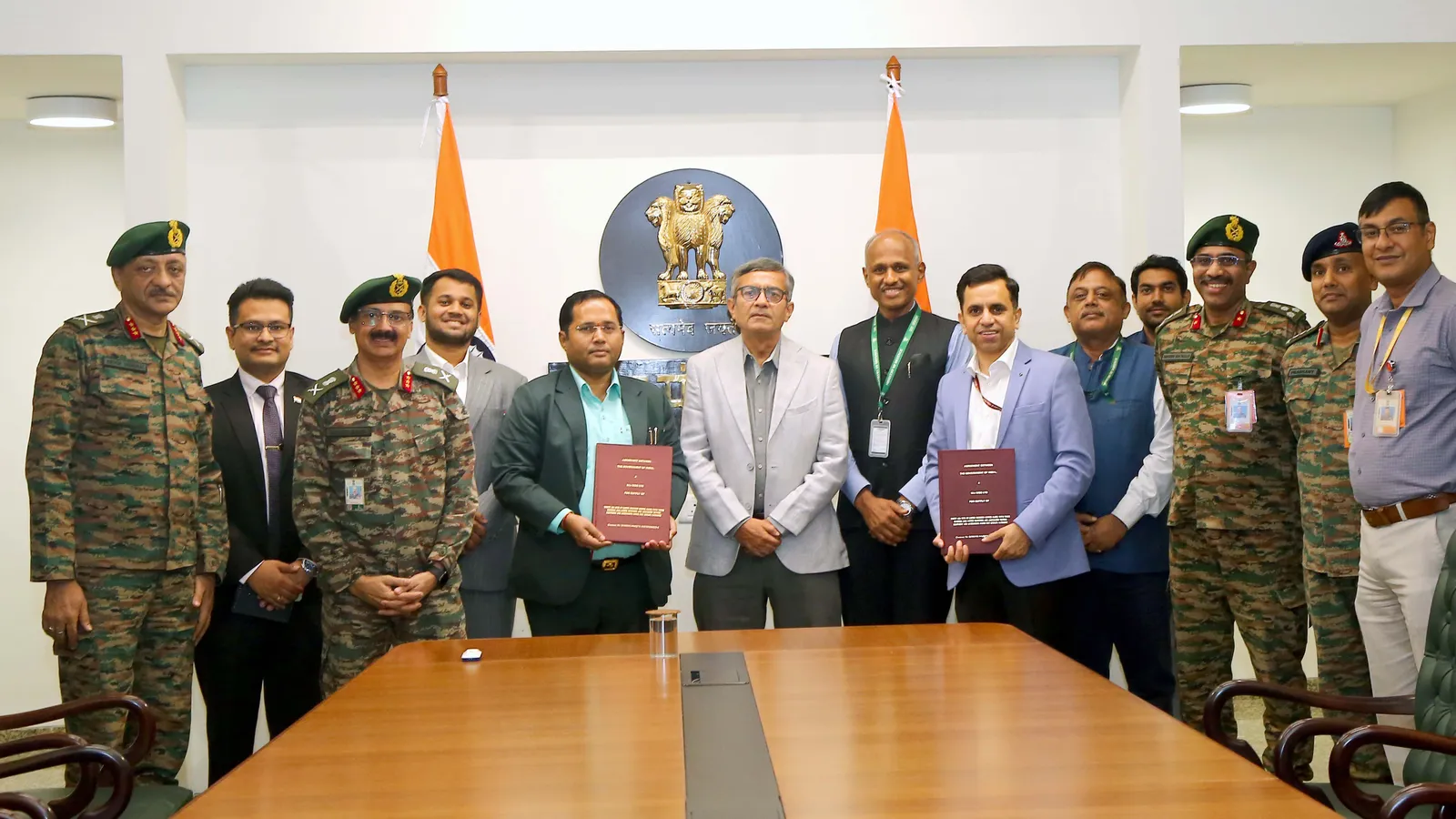
Eight hundred and forty munitions, each with a reach of up to 100 km, all of them due within a year. That is the arithmetic behind the ₹1,577 crore contracts the Ministry of Defence signed in New Delhi on 14 August with Tata Advanced Systems Limited and NIBE Private Limited for loiter munition systems for the Indian Army — the first large loitering-munition order since Operation Sindoor, and the clearest sign yet of how the Artillery intends to buy its strike drones from here on.
The package covers 84 loiter munition systems and 840 munitions, plus accessories, with the Army’s Artillery Regiments as the end user. Ten munitions per system, a little under ₹19 crore per system with its ammunition and accessories included, and a delivery clock that runs 12 months from the advance payment; supplies are expected to start within six months of signing. The contracts were signed in the presence of Defence Secretary Rajesh Kumar Singh.
A 64:36 split between two private vendors
Rather than hand the entire order to a single winner, the ministry divided it between the two lowest bidders. Tata Advanced Systems, as L-1, takes 64 per cent: 54 systems and 540 munitions, worth about ₹1,000 crore. NIBE, as L-2, takes the remaining 36 per cent: 30 systems and 300 munitions, worth about ₹580 crore. Both are private-sector firms; no defence public sector undertaking figures in the order.
The practical effect is two production lines instead of one. For an item the Army expects to consume in quantity, that matters more than the gap between the bids: a single line delivering 840 munitions in 12 months is a stretch, while two lines sharing the load is a plan. It also leaves the ministry with a second qualified source when the next tranche comes up, which reports suggest will not be long. The Army’s wider loitering-munition requirement is put in the thousands, and follow-on buys for systems with ranges beyond 1,500 km are anticipated.
Fast Track, with an indigenous floor
The procurement went through under the Buy (Indian) category via the Fast Track Procedure, the ministry’s abbreviated route for buys it cannot afford to run through a full acquisition cycle. The indigenous-content clause is the detail worth reading twice. The contract requires 60 per cent overall indigenous content, with at least 50 per cent in materials, components and software. The second figure is the one with teeth: it stops a vendor from meeting the headline number through local assembly and labour while importing the airframe, seeker and guidance stack. For a loitering munition, where the software is the weapon as much as the warhead is, a 50 per cent floor that explicitly covers software is a meaningful demand on both vendors.
The munitions are designed to function under heavy jamming and spoofing — a specification that assumes the weapon will be flown into a contested electromagnetic environment rather than a permissive one, and that its navigation and data link must survive deliberate interference for the full 100 km of its reach.
The ministry said the systems will “strengthen the operational capabilities of the Indian Army, particularly its Artillery Regiments,” and framed the order as a contribution to Aatmanirbhar Bharat.
Why the template matters more than the number
Loitering munitions sit in an awkward place in the Army’s inventory: too numerous to buy like missiles, too lethal to buy like surveillance drones. The 14 August contracts settle several open questions at once. The Artillery, not a separate drone arm, owns them. Private vendors, not a public-sector monopoly, build them. Orders are split rather than concentrated. Delivery is measured in months, not years. And indigenous content is enforced at the component level, not the invoice level.
If the wider requirement really is in the thousands, and if the next tranche really does reach beyond 1,500 km, then the 84 systems signed for this month are less a purchase than a proof of process. The shape of the order, more than its size, is what the Army has just committed to — and it is the shape the longer-range buys are expected to follow.
Sources
- 1. AIR News: Defence Ministry signs ₹1,577 crore contracts for loiter munition systems — newsonair.gov.in
- 2. Bharat Shakti: NIBE, Tata bag Rs 1,577 crore Army contracts for loiter munitions — bharatshakti.in
- 3. Business Today: Indian Army signs Rs 1,577 crore drone contracts with Tata, NIBE for 840 long-range attack drones — businesstoday.in
- 4. Business Standard: Tata, NIBE to arm Army with loitering munitions under Rs 1,577 crore deal — business-standard.com
- 5. DD News: Defence Ministry signs Rs 1,577 crore contracts with Tata Advanced Systems, NIBE for loiter munition systems — ddnews.gov.in
- 6. idrw.org: MoD inks Rs 1,577 crore deal with TASL and NIBE for indigenous loiter munition systems — idrw.org
Senapathi Desk
Staff reports & analysis
The Senapathi Report news desk. Original reporting and analysis synthesised from multiple corroborated sources — defence procurement, service developments and regional security, filed as it happens.