
Pakistan Inducts First Chinese Hangor-Class Submarine, Eyes Bay of Bengal Foray
The first of eight Chinese-built AIP boats — and reported plans for Pakistan's first Bay of Bengal submarine deployment since 1971 — sharpen an undersea contest that India's delayed P-75I programme has yet to answer.

Senapathi Desk
Staff reports & analysis
Published
3 min read
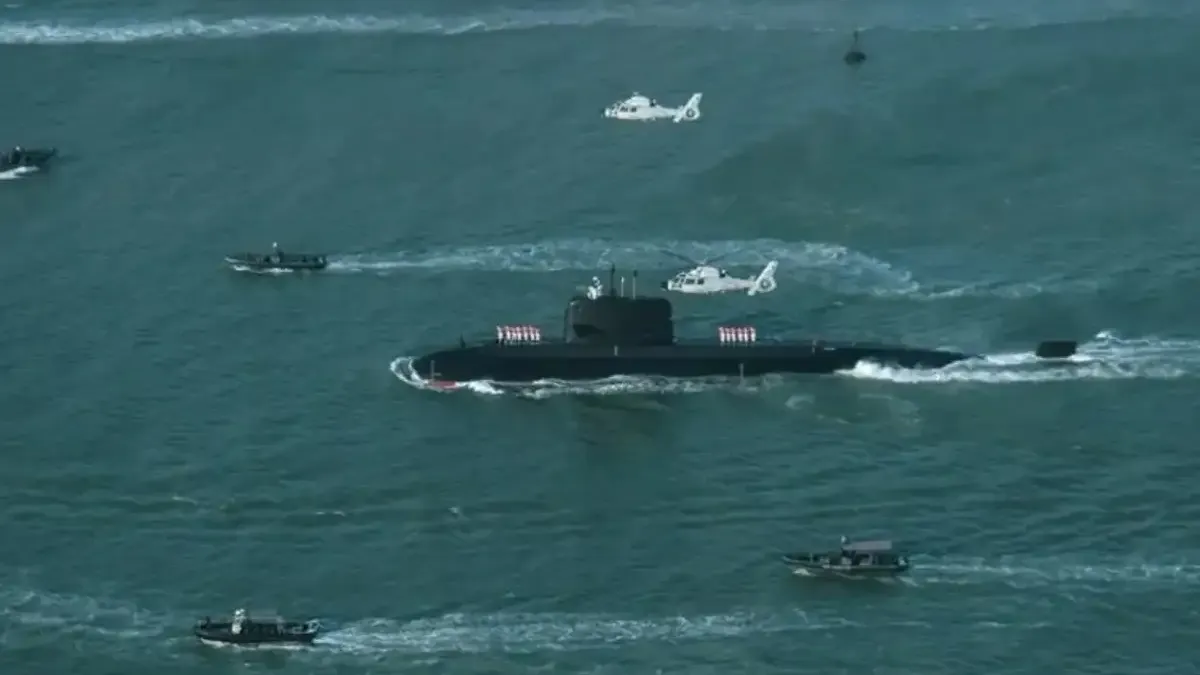
More than half a century after Pakistan’s navy was driven from the Bay of Bengal in the 1971 war, multiple reports in India say it intends to send a submarine back. The boat expected to carry that message arrived at Karachi Port on 11 June: the first of eight Hangor-class submarines Pakistan has ordered from China, and the opening move in the most consequential reshaping of the undersea balance in South Asia in years.
The induction matters for three reasons, and each is worth unpacking in turn: what the submarine itself brings, what its reported destination signals, and what it exposes about the state of India’s own submarine plans.
What Pakistan Is Getting
Start with the boat. The Hangor class is a Chinese-built diesel-electric submarine fitted with air-independent propulsion, or AIP. A conventional submarine must periodically come up to snorkelling depth to run its diesel generators and recharge its batteries — the moment it is most exposed to detection. AIP sidesteps that vulnerability by generating power without drawing air from the surface, letting the boat stay fully submerged for much longer stretches of a patrol. For a navy whose submarines will operate in waters watched closely by Indian maritime patrol aircraft and warships, that endurance is the whole point.
The boat is armed through 533mm torpedo tubes, the standard bore for heavyweight torpedoes. Seven more hulls are to follow under the contract with China, meaning the class will eventually form the backbone of Pakistan’s submarine arm rather than a niche capability.
The Pakistan Navy called the arrival a milestone in its modernisation programme, and the description is not just ceremonial. The deal has been characterised as China’s most significant defence export to any navy — a transfer that extends China’s military footprint deeper into the Indian Ocean without a single Chinese warship needing to be present. Every Hangor on patrol is, in effect, an advertisement for Chinese naval industry and an extension of the two countries’ strategic alignment into the undersea domain.
Why the Bay of Bengal Matters
The reported first destination is where the story acquires its edge. According to several accounts, Pakistan plans to deploy the new submarine to the Bay of Bengal — something it has not done since the 1971 war, when the conflict over what was then East Pakistan ended in a decisive naval defeat and the loss of its eastern wing. Indian forces are reported to be on alert for what one account called the “return foray”.
A single diesel-electric submarine in the Bay of Bengal does not change the military balance there. India’s eastern seaboard hosts substantial naval forces, and any Pakistani boat operating that far from home would be at the end of a long and unsupported transit. But deployments of this kind are rarely about combat power. The message, as one reading of the move puts it, is that Pakistan believes it can once again challenge India on its eastern flank, fifty-five years after being expelled from those waters. For a navy that has spent decades confined largely to the Arabian Sea, simply demonstrating the reach — and doing it in an AIP boat that is genuinely hard to track — is the achievement.
For India, the operational question is narrower but real: finding a quiet, air-independent submarine in a body of water as large as the Bay of Bengal is a demanding anti-submarine exercise, and every such deployment forces India to spend surveillance aircraft hours, ship days and attention on its eastern flank that were previously reserved for the west.
That is where the induction lands hardest. India’s own programme to field comparable AIP submarines, Project 75I, has been delayed for years, leaving a gap between the threat now materialising and the answer meant to meet it. Pakistan, by contrast, has a fixed pipeline: seven more Hangors to come.
The things to watch from here are concrete. Does the reported Bay of Bengal deployment actually happen, and how does India choose to shadow it? How quickly do the remaining boats arrive? And does the pressure of a growing Chinese-built AIP fleet next door finally force India’s delayed submarine programme onto a schedule? The first Hangor is one boat. The trajectory it announces is the real story.
Sources
- 1. First Hangor-class submarine arrives at Karachi Port — dawn.com
- 2. Pakistan's new Chinese-built stealth submarine and the signal to India — scmp.com
- 3. India on alert for Pakistani submarine's Bay of Bengal 'return foray' — thehansindia.com
- 4. PNS Hangor, China's delivery and the Bay of Bengal question — independent.co.uk
Senapathi Desk
Staff reports & analysis
The Senapathi Report news desk. Original reporting and analysis synthesised from multiple corroborated sources — defence procurement, service developments and regional security, filed as it happens.