India, China Agree Two New LAC Hotlines, Meeting Points in Eight-Point Beijing Consensus
The 25th Special Representatives round yields the first concrete de-confliction package since the 2024 Depsang-Demchok disengagement: two more hotlines, two more meeting points, a delimitation early-harvest track and a 2027 round in India.

Senapathi Desk
Staff reports & analysis
Published
3 min read
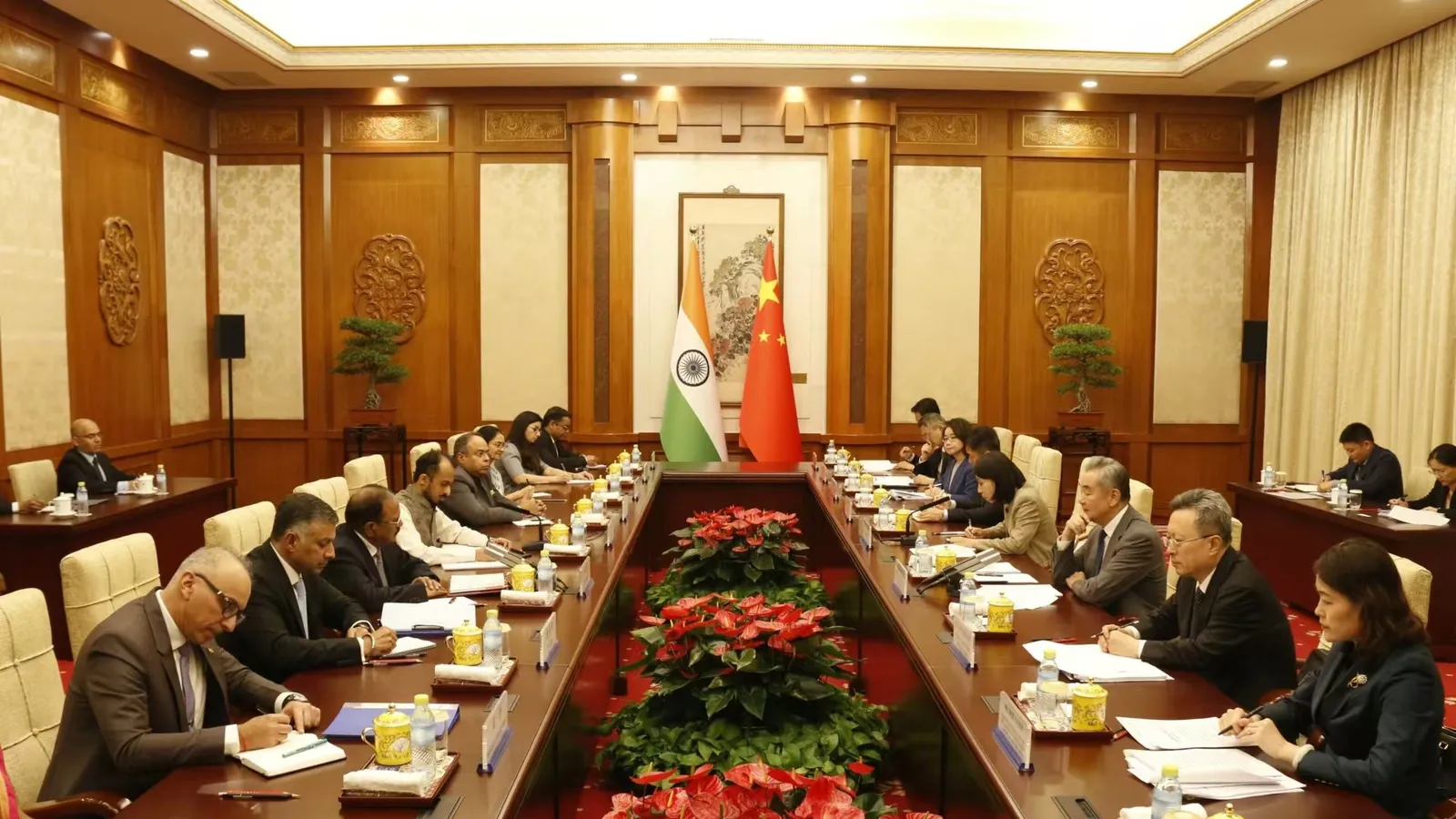
India and China will open two additional military hotlines in the eastern and middle sectors of the Line of Actual Control and add two new meeting points for senior commander-level talks, under an eight-point package agreed by National Security Adviser Ajit Doval and Chinese Foreign Minister Wang Yi at the 25th round of Special Representatives talks in Beijing on 25 August.
The package, described by both governments as “eight points of outcomes and consensus”, is the first concrete set of de-confliction measures since the October 2024 disengagement at Depsang and Demchok closed out the last friction points of the 2020 standoff. Its centrepiece is communications: the new hotlines and meeting points extend the military-to-military channels that have so far been concentrated where the confrontation happened, to sectors of the boundary that have been quieter but never settled.
The second track is the boundary itself. An Expert Group on Boundary Delimitation and a Working Group on Border Management, both under the Working Mechanism for Consultation and Coordination on India-China Border Affairs, have been tasked with advancing what the readouts call an “Early and Substantial Harvest of boundary delimitation and Border Management”. Day-to-day situations on the ground are to continue to be handled through existing channels, including the WMCC, keeping the delimitation exercise separate from incident management.
The remaining outcomes are the confidence-building ledger. The two sides agreed to reopen three designated border trading points, to increase the number of pilgrim batches travelling to Mount Gang Renpoche and Lake Mapam Yun Tso, and to convene the Expert-Level Mechanism on trans-border rivers in September. India had pressed for the early convening of that mechanism, along with the sharing of technical details on upstream projects, hydrological data and the renewal of lapsed memoranda, and the September date is the first tangible response.
External Affairs Ministry spokesperson Randhir Jaiswal set out the government’s reading of the deal on 28 August. “Both sides have agreed on an eight-point agenda, and now it is for both sides to sit together and see how best it can be activated,” he said. The formulation is deliberate: the consensus is a work programme, and the mechanisms named in it are where the substance will be tested.
Doval was in Beijing on 24 and 25 August and also called on Vice President Han Zheng during the visit. The ministry’s readout noted that both sides recorded progress on the consensus reached by the two leaders at Kazan in October 2024 and at Tianjin in August 2025. Direct flights have resumed, the Kailash Manasarovar Yatra has restarted and border trade through the three designated passes is under way, a sequence that has moved the relationship from managing a crisis to re-establishing routine contact. Doval told his counterpart that peace and tranquility on the border remain essential for progress in the wider relationship, the position India has held since the 2020 clashes and one the eight-point package is designed to operationalise rather than replace.
The groundwork was laid at the 36th meeting of the WMCC in New Delhi on 6 August, co-chaired by Hou Yanqi and Sujit Ghosh, which prepared the agenda for the Special Representatives round three weeks later.
For the armed forces, the practical gain is redundancy. Hotlines and fixed meeting points give local commanders a way to raise a patrol encounter or a construction dispute before it escalates, and putting them in the eastern and middle sectors closes a gap in coverage along a frontier where both sides have been building roads, airfields and forward infrastructure. The delimitation track is the longer bet. An “early harvest” formula has been on the table in one form or another for years, typically pointing to the middle sector, where the two sides’ maps diverge least, as the segment where an agreed line is most achievable. Naming an expert group and a working group with that brief gives the idea a bureaucratic home for the first time in this cycle.
None of the eight points resolves the underlying dispute, and the readouts do not claim otherwise. What they establish is a schedule: the rivers mechanism in September, the expert and working groups reporting through the WMCC, and the 26th round of Special Representatives talks to be hosted by India in 2027. Whether the consensus is “activated”, in Jaiswal’s phrase, will be measured against those dates.
Sources
- 1. Business Today: India, China agree to advance boundary delimitation talks, prevent LAC miscalculation — businesstoday.in
- 2. ANI: India, China to see how best to activate 8-point consensus from 25th SR talks, says MEA — aninews.in
- 3. ANI: Expert Group to advance discussions on early and substantial harvest of India-China boundary delimitation, says MEA — aninews.in
- 4. India TV: Doval-Wang talks yield eight key outcomes on LAC peace and hotlines — indiatvnews.com
- 5. ThePrint: NSA Doval says peace and tranquility essential for progress in India-China ties at meeting with Wang Yi — theprint.in
- 6. Indian Defence News: India and China expand border communication channels after 25th SR talks — indiandefensenews.in
Senapathi Desk
Staff reports & analysis
The Senapathi Report news desk. Original reporting and analysis synthesised from multiple corroborated sources — defence procurement, service developments and regional security, filed as it happens.