Indian Navy Sends P-8I Sub-Hunter to Hawaii for RIMPAC 2026, World's Largest Naval Drill
India's frontline anti-submarine aircraft joins the 30th edition of RIMPAC off Hawaii, folding into a month-long drill with the United States, Japan and Australia as the Navy sharpens its ASW edge in the Indo-Pacific.

Senapathi Desk
Staff reports & analysis
Published
2 min read
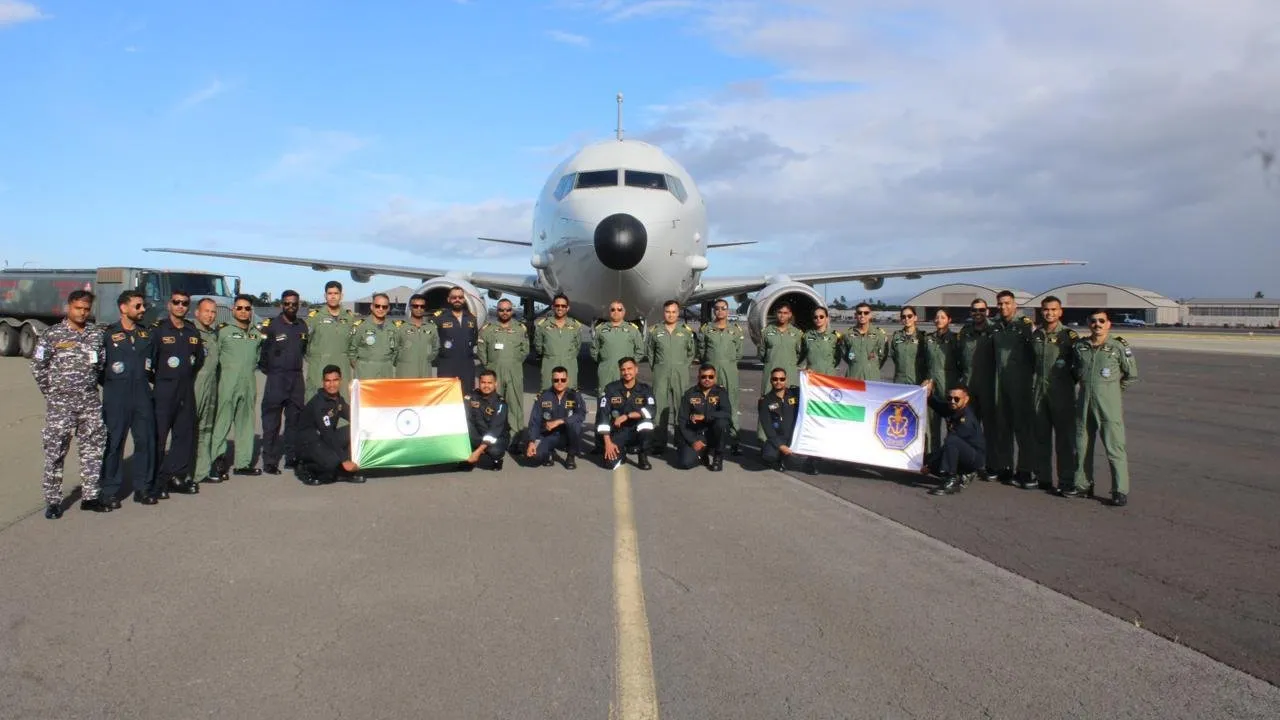
The world’s largest naval exercise has convened off Hawaii for its 30th edition, and India’s contribution this time is not a warship but a single aircraft. That choice is revealing. On 4 July, the Indian Navy dispatched a P-8I long-range maritime reconnaissance and anti-submarine warfare aircraft to join Rim of the Pacific — RIMPAC — 2026, a signal that the skill it most wants to hone alongside its partners is the hardest one in naval warfare: finding submarines.
Start with what RIMPAC is. Hosted by the United States in the waters around Hawaii, the exercise draws roughly 30 nations this year, making it the largest gathering of naval power anywhere. For the Indian aircraft and its crew, the assignment is a month-long drill conducted alongside the United States, Japan and Australia — the other three members of the Quad grouping — with anti-submarine warfare at the heart of the syllabus.
Why send a sub-hunter?
The P-8I is the Indian Navy’s frontline maritime patrol aircraft: a militarised airliner that can range far out to sea, sweep enormous stretches of ocean, and localise and track submarines that surface ships would struggle to find. At home it serves as the Navy’s eyes over distant sea lanes in the Indian Ocean. At RIMPAC it becomes something more interesting — one node in a multinational hunting network.
That matters because anti-submarine warfare is a team sport. A patrol aircraft rarely prosecutes a contact alone; it works with ships, helicopters and other aircraft, handing tracks back and forth over shared communications. Rehearsing that choreography with the United States and Australia — both of which fly the same Poseidon airframe family on which the P-8I is built — lets Indian crews practise a common tactical language with partners they are increasingly likely to operate beside.
The interoperability dividend
The word attached to deployments like this is interoperability, and it is worth unpacking. In practice it means radio and data procedures that mesh, sensor pictures that can be fused into one, and crews that have solved hard problems together before a crisis forces them to improvise. The deployment underlines India’s push for exactly that, in service of a free and open Indo-Pacific — shorthand for a region where sea lanes stay open and no single power dictates terms.
There is a quieter signal too. Sending the Navy’s premier anti-submarine platform to an exercise hosted by the United States, rather than a token surface presence, suggests a willingness to expose and refine the sharp end of India’s maritime surveillance arsenal in front of close partners.
None of this produces a dramatic headline on day one. The returns from a month at RIMPAC arrive later and more quietly: procedures validated against unfamiliar opponents, contacts and lessons logged, and a habit of cooperation that cannot be conjured in a crisis. When the P-8I flies home from Hawaii, the most valuable cargo aboard will be what its crew learned hunting alongside 30 navies — and how much easier the next combined patrol becomes because of it.
Sources
- 1. India sends sub-hunter aircraft to US-hosted RIMPAC war game — newindianexpress.com
- 2. P-8I deployment to Hawaii underlines India's Indo-Pacific interoperability push — indiatoday.in
- 3. Indian Navy dispatches P-8I to Hawaii for exercise RIMPAC 2026 — indiasentinels.com
Senapathi Desk
Staff reports & analysis
The Senapathi Report news desk. Original reporting and analysis synthesised from multiple corroborated sources — defence procurement, service developments and regional security, filed as it happens.