OSINT Count Puts China's J-35 Fleet Past 30 as Stealth Production Accelerates
Open-source analysts now count more than 30 J-35s, with output accelerating. In South Asia the figure reads as a countdown: Pakistan signed for the jet in May, and India's own fifth-generation fighter has yet to fly.

Senapathi Desk
Staff reports & analysis
Published
3 min read
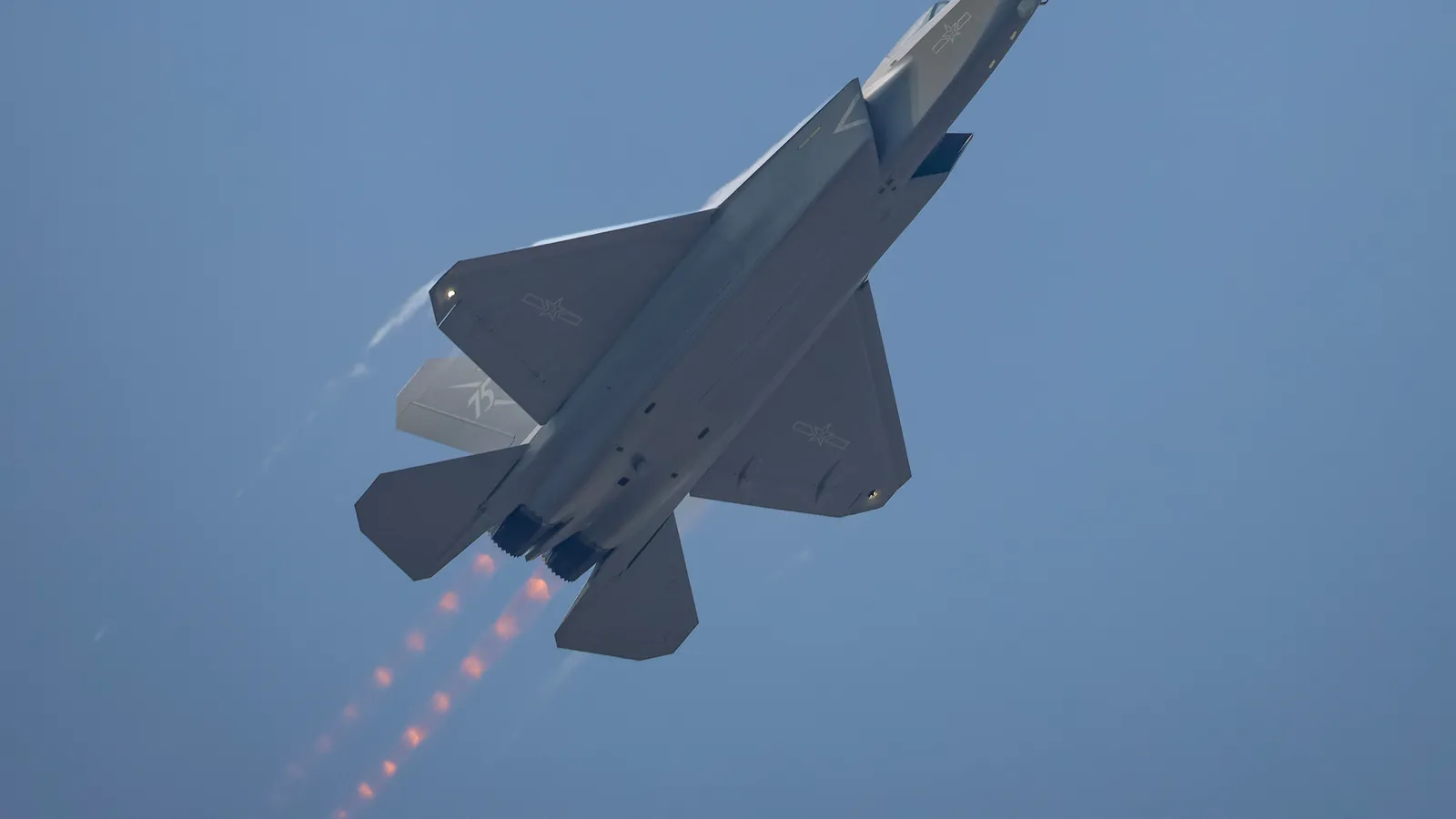
Thirty. That is the number open-source analysts now attach to China’s J-35 stealth fighter fleet — more than 30 airframes counted by the end of June, with output from Shenyang’s production line described as accelerating. As a force in being, 30 jets is modest. As a point on a curve, it is something else entirely: the moment China’s second fifth-generation fighter visibly crossed from development programme to serial production, with the slope still steepening.
The J-35 is Shenyang’s mid-weight stealth fighter, built in carrier-capable and land-based versions, the latter designated J-35A. What distinguishes the programme is not any single airframe but the industrial context around it — because the 30-plus figure is best read next to a much larger one. China’s factories are estimated to be turning out 100 to 120 J-20 stealth fighters every year, and the J-35 line now runs alongside that output rather than in place of it. Two fifth-generation production lines, running simultaneously, is the headline behind the headline. The analytical argument attached to those numbers is blunt: China’s stealth fighters do not need to beat the best Western types one-for-one, because China intends to build enough of them that they will not have to. Quality arguments are settled in test reports; quantity arguments are settled on factory aprons, and the aprons are where the evidence is piling up.
Counts of this kind also tend to understate. Open-source fleet tallies are assembled from satellite imagery, factory-line photographs and airframe tracking, and they lag the flight line rather than lead it. A figure of “more than 30”, published at the end of June and paired with the word “accelerating”, is the kind of number that dates quickly — which is precisely why it is worth tracking.
The Queue That Matters in South Asia
For India, the most important consequence of the production rate is who stands in the delivery queue. The Pakistan Air Force secured a deal for the J-35 in May, and the industrial data bears directly on when that contract turns into capability. Export aircraft come out of the same capacity that builds China’s own fleet, so every improvement in Shenyang’s output rate compresses the plausible gap between signature and squadron service. A line trickling out a few airframes a year would have made Pakistan’s J-35s a next-decade problem. A line accelerating past 30 cumulative aircraft makes them a this-decade one.
India’s side of the ledger is thin. The Indian Air Force fields no stealth fighter, and the indigenous Advanced Medium Combat Aircraft — its designated answer to precisely this scenario — has yet to fly. If deliveries to Pakistan track anything like the production curve now visible, India could face fifth-generation fighters across its western border years before it can put one of its own into service, with a far larger J-20 fleet already standing across the northern one. The two-front problem Indian planners have long war-gamed in the abstract would then take a specific, countable shape: their stealth aircraft, built at these rates, against India’s zero.
The indicators from here are narrow and numerical. Watch how fast the open-source tally climbs past 30 in subsequent imagery, whether J-20 output holds in the 100-to-120 band, and when the first J-35 in Pakistani markings appears. Fighter programmes generate endless argument about capability; production counts end those arguments one airframe at a time. The current count is 30 and rising.
Sources
- 1. Shenyang reportedly surpasses 30 J-35s as fifth-generation production accelerates — zona-militar.com
- 2. Pakistan's J-35 deal and the test that follows — thediplomaticinsight.com
- 3. China's stealth fighter output and the case for quantity over parity — 19fortyfive.com
Senapathi Desk
Staff reports & analysis
The Senapathi Report news desk. Original reporting and analysis synthesised from multiple corroborated sources — defence procurement, service developments and regional security, filed as it happens.