Modi Commissions Three Indigenous Warships in Rare Triple Ceremony at Kolkata
INS Dunagiri, INS Sanshodhak and INS Agray joined the fleet together on 21 June — a GRSE production milestone underscoring India's shift from defence buyer to builder as China widens its Indian Ocean footprint.

Senapathi Desk
Staff reports & analysis
Published
2 min read
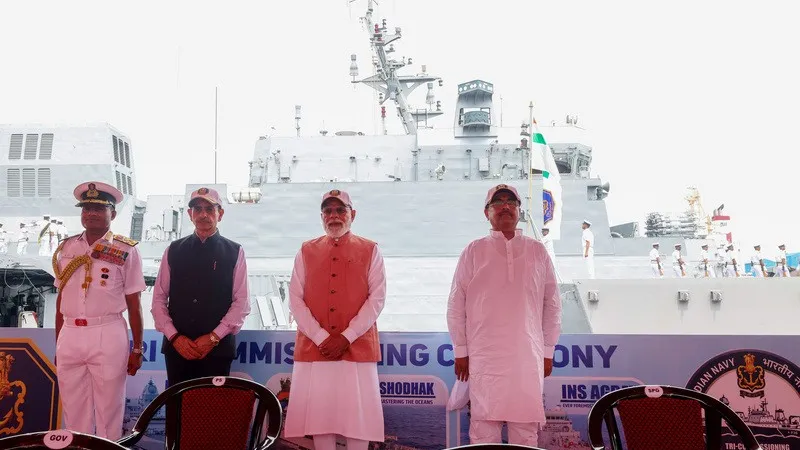
KOLKATA — India commissioned three indigenously designed and built warships in a single ceremony on 21 June, an unusual triple induction presided over by Prime Minister Narendra Modi at Syama Prasad Mookerjee Port in Kolkata.
The vessels are the Nilgiri-class stealth frigate INS Dunagiri, the Survey Vessel (Large) INS Sanshodhak and the Anti-Submarine Warfare Shallow Water Craft INS Agray. All three were built by Garden Reach Shipbuilders and Engineers (GRSE), the state-owned yard in Kolkata. Each carries more than 75 per cent indigenous content, the government said.
Modi framed the ceremony as proof of India’s transition from a buyer of defence equipment to a builder of it. He also noted that 21 June is marked as World Hydrography Day — a fitting date, he said, for the induction of a survey ship.
Commissioning three warships of three different classes on the same day, from the same yard, is rare for the Indian Navy. Officials presented the event as a milestone for domestic naval shipbuilding, demonstrating that an Indian yard can deliver combatants, survey platforms and coastal specialists in parallel rather than one hull at a time.
The three ships answer three distinct requirements. INS Dunagiri is a frontline surface combatant, a stealth frigate of the Nilgiri class built for blue-water operations. INS Sanshodhak is a large survey vessel whose job is hydrography — charting waters and mapping the seabed, work that underpins both safe navigation and naval operations. INS Agray is built to hunt submarines in shallow coastal waters, a layer of defence closest to India’s own shoreline.
The timing carries strategic weight. The induction lands against the backdrop of China’s expanding presence in the Indian Ocean, and analysts have framed the simultaneous arrival of a frigate, a survey ship and an anti-submarine craft as a signal that India is thickening its maritime posture across the full spectrum — open-ocean combat power, undersea domain awareness and littoral defence — rather than in one dimension alone.
The choice of venue carried its own message. GRSE’s yard sits in Kolkata, and commissioning the ships at the city’s Syama Prasad Mookerjee Port kept the ceremony at the doorstep of the workforce that built them.
For the shipbuilder, the day was a public demonstration of throughput. Delivering three commissioned warships simultaneously — each of a different type, each majority-Indian in content — is the kind of output the government has been demanding from domestic yards as it pushes to cut dependence on foreign suppliers.
The three ships now join the fleet with immediate work ahead of them: Dunagiri with the surface force, Sanshodhak on survey duties, and Agray watching the shallows for submarines. Together they add reach, eyes and teeth to a navy contending with a more crowded ocean.
Sources
- 1. PIB release on triple commissioning — pib.gov.in
- 2. PM India statement on commissioning of INS Dunagiri, INS Sanshodhak and INS Agray — pmindia.gov.in
- 3. Naval News report on the three inductions — navalnews.com
- 4. Indian Express explainer on the three ships' roles — indianexpress.com
- 5. Asian Military Review on simultaneous commissioning — asianmilitaryreview.com
- 6. Daily Pioneer on made-in-India warships joining the fleet — dailypioneer.com
Senapathi Desk
Staff reports & analysis
The Senapathi Report news desk. Original reporting and analysis synthesised from multiple corroborated sources — defence procurement, service developments and regional security, filed as it happens.