Half the Radar Signature: India, Japan Sign First Joint Defence Project on UNICORN Mast
A mast that can halve a warship's radar cross-section is the object of India and Japan's first-ever military hardware co-development deal, signed in New Delhi on 2 July under Japan's relaxed export rules.

Senapathi Desk
Staff reports & analysis
Published
3 min read
Half. By reported design estimates, that is how much of a warship’s radar cross-section can vanish when the forest of antennas crowding its superstructure is folded into a single sealed mast. That one figure — a cut of as much as 50 per cent in the most trackable signature a surface ship presents — sits at the centre of the agreement India and Japan signed in New Delhi on 2 July: the first piece of military hardware the two countries have ever agreed to co-develop and co-produce.
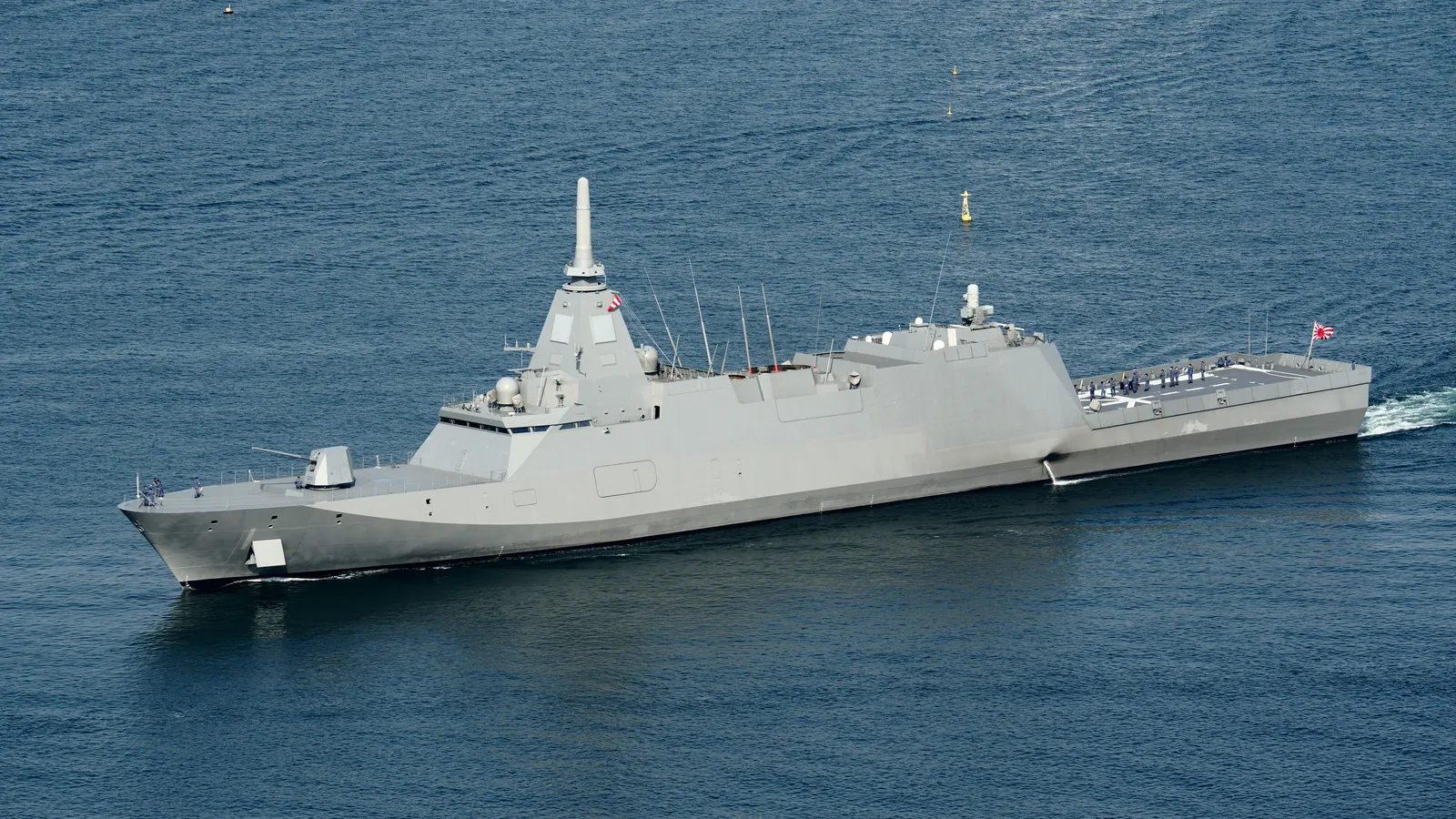
The system is the Unified Complex Radio Antenna, or UNICORN. A conventional warship carries its radar, communications and electronic-warfare antennas as separate fittings, each one a reflector that returns energy to a searching radar. UNICORN consolidates them inside one enclosed radome on a single mast, smoothing the ship’s profile and, with it, shrinking the return an adversary’s sensors can lock on to. The design is not a laboratory promise: it already serves at sea on Japan’s Mogami-class frigates, so the Indian Navy would be adopting hardware with an operational record rather than underwriting an experiment.
The numbers behind the signature tell the story of how deliberately this deal was built. Twenty months separate the agreement from the memorandum of implementation the two governments signed in Tokyo on 15 November 2024. The signing itself was timed to the summit between Prime Minister Narendra Modi and Prime Minister Sanae Takaichi. And the industrial arrangement spans four companies: Bharat Electronics Limited leads development on the Indian side, while Japan’s contribution runs through NEC Corporation, Sanwa Kogyo and Yokohama Rubber Company.
From 77 to 40
The larger arithmetic is about where India buys its weapons. Russia’s share of India’s arms imports fell to 40 per cent across 2020–2025, down from 77 per cent in the preceding period — a diversification drive that has so far leaned on France, the United States and Israel. Japan’s entry adds a supplier that, until it eased its postwar restrictions on defence exports, was effectively absent from the market. Those relaxed rules are what made this project legally possible, and the UNICORN agreement is the first India–Japan joint defence technology initiative to come through the opening.
Markets registered the shift, if modestly. The Nifty India Defence Index rose 0.53 per cent in the session after the pact was announced, a small move that nonetheless marked the deal as a sentiment event for the sector rather than a diplomatic footnote.
The most telling numbers, though, may be the ones that do not exist yet. No contract value was disclosed, no quantities, no completion timeline. At signature, this is a framework — the scale, cost and delivery schedule remain blanks to be filled as development proceeds. That caveat matters: co-development programmes are judged on execution, and the distance between a signed agreement and a mast standing on an Indian warship is where such projects are won or lost.
Even so, the known figures set the stakes clearly enough. One mast in place of many. A radar signature reduced by as much as half. Twenty months from memorandum to agreement. Four companies across two countries. And an Indian import ledger that no longer routes 77 per cent of its purchases through a single supplier. For a first joint project, the two governments have picked something measurable — which means, in time, everyone will be able to count whether it delivered.
Sources
- 1. India, Japan sign first military hardware co-development deal on stealth UNICORN mast — indiasentinels.com
- 2. How UNICORN masts will give Indian warships greater stealth — timesofindia.indiatimes.com
- 3. First defence co-development project deal signed with Japan — newindianexpress.com
- 4. Indo-Japan pact on stealth UNICORN antenna mast to boost Indian Navy capabilities — thehindubusinessline.com
- 5. Nifty India Defence rises 0.53% as India-Japan pact lifts sector sentiment — hdfcsky.com
- 6. India, Japan deepen defence technology and MSME ties — msn.com
Senapathi Desk
Staff reports & analysis
The Senapathi Report news desk. Original reporting and analysis synthesised from multiple corroborated sources — defence procurement, service developments and regional security, filed as it happens.