Ukraine's Drones Knock Out 43% of Russian Refining, Forcing Fuel Imports From India
Deep strikes have achieved what no front-line offensive managed — a nationwide Russian fuel crisis conceded by Putin himself, pushing one of the world's great oil powers into seaborne gasoline imports, including from India.

Senapathi Desk
Staff reports & analysis
Published
3 min read
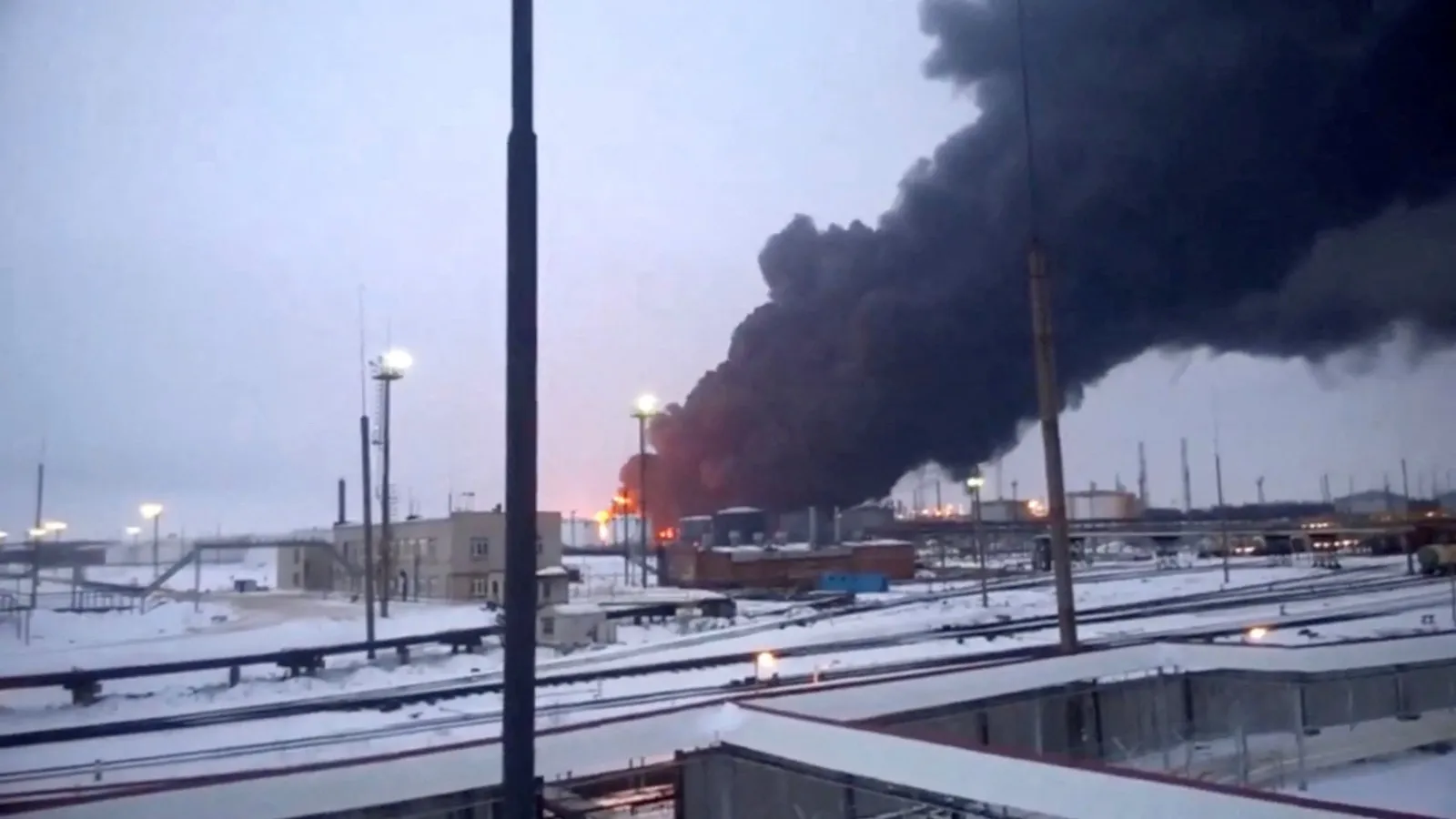
One of the largest oil producers on earth is now buying gasoline by ship. According to two industry sources, Russia has begun seaborne imports of gasoline from India to plug shortages at home — a transaction so contrary to the natural order of the energy trade that it functions as a battle damage assessment all by itself.
The damage behind it is extensive. Ukraine’s systematic long-range drone campaign has knocked out 42.7 percent of Russia’s projected oil refining capacity, according to an assessment by Ukraine’s defence forces. Months of strikes have set refineries ablaze faster than they can be repaired, and the result is a summer fuel crisis with growing lines at Russian filling stations. The tempo has not slackened: in early July, Ukraine’s president said one Russian refinery had been hit for the second time in a single week. Even Russia’s president has stopped pretending otherwise. On 28 June he acknowledged that Ukrainian strikes on infrastructure were causing “obvious” problems with fuel — while insisting they were “not critical” — the first time he has publicly detailed the campaign’s impact.
That admission deserves more attention than the caveat attached to it. Leaders of wartime autocracies do not concede enemy successes as a matter of candour; they concede them when the evidence has become impossible to manage. A queue at a filling station is the least deniable form of intelligence there is. When denial costs more credibility than admission, the information battle over that subject has already been lost — and pre-empting public anger becomes the safer play.
The deeper story is why this campaign works when so much else has not. Refineries are close to ideal targets for cheap, long-range drones: enormous, immobile, filled with flammables, and scattered across a landmass too vast for any air defence network to blanket. Every interceptor battery pulled back to guard a refinery is a battery not covering the front line. Ukraine has, in effect, forced its opponent to choose between protecting its army and protecting its economy, at a cost per drone that is trivial beside the value of what burns.
Just as deliberate is what Ukraine is not hitting. The campaign targets refining, not extraction. Crude exports — the revenue stream Russia’s partners and customers watch, and the input global markets price — keep flowing. What burns is the capacity to turn that crude into the gasoline and diesel Russian consumers and the war economy run on. It is economic warfare tuned to a political constraint: hurt Russia’s home front without spiking world oil prices and testing the patience of Ukraine’s backers.
Russia’s countermoves all run into the same walls. Air defence cannot be everywhere. Rebuilding sophisticated refinery units is slow and expensive under sanctions that constrain access to specialised equipment. Exhortation does not put fuel in pumps. That leaves imports — and here the second-order effects turn ironic. India built itself into a leading buyer of discounted Russian crude after 2022; its refiners now stand on the other side of the ledger, selling finished gasoline back to the country that supplies their feedstock. For India this is straightforward commercial logic and a demonstration of its refining muscle. It is also quiet leverage: Russia now depends on India at both ends of the barrel.
The honest caveat is that fuel scarcity has not yet been shown to bend the front line. Militaries insulate their own supply first; civilians absorb the shortage. But that is precisely what makes the campaign political rather than merely economic. The strategic bombing campaigns of the last century mostly failed to break industrial economies quickly — yet none of those targets was forced, within months, to import the very product it was famous for exporting. Whether or not 42.7 percent is the number that matters, the tanker manifests are. A war Russia has framed as existential is now being subsidised at the pump by seaborne gasoline, and everyone standing in line can see it.
Sources
- 1. Russia begins seaborne gasoline imports from India, industry sources say — reuters.com
- 2. Putin admits Ukrainian strikes are driving Russian fuel shortages — theguardian.com
- 3. Ukrainian forces assess 42.7% of Russian refining capacity knocked out — kyivpost.com
- 4. Summer fuel crisis brings growing lines to Russian filling stations — apnews.com
Senapathi Desk
Staff reports & analysis
The Senapathi Report news desk. Original reporting and analysis synthesised from multiple corroborated sources — defence procurement, service developments and regional security, filed as it happens.