
J-15T Now Flying From All Three Chinese Carriers — and the Clock Starts for India
China's upgraded J-15T is operating from Liaoning, Shandong and Fujian alike. One interchangeable fighter across three decks changes the tempo of Chinese naval aviation — and shortens India's own decision timelines.

Senapathi Desk
Staff reports & analysis
Published
2 min read
The hard question in carrier aviation was never whether a jet can get off a deck. It is how quickly a navy can turn that jet into repeatable, sustainable combat power — and on that measure, China has just moved the goalposts.
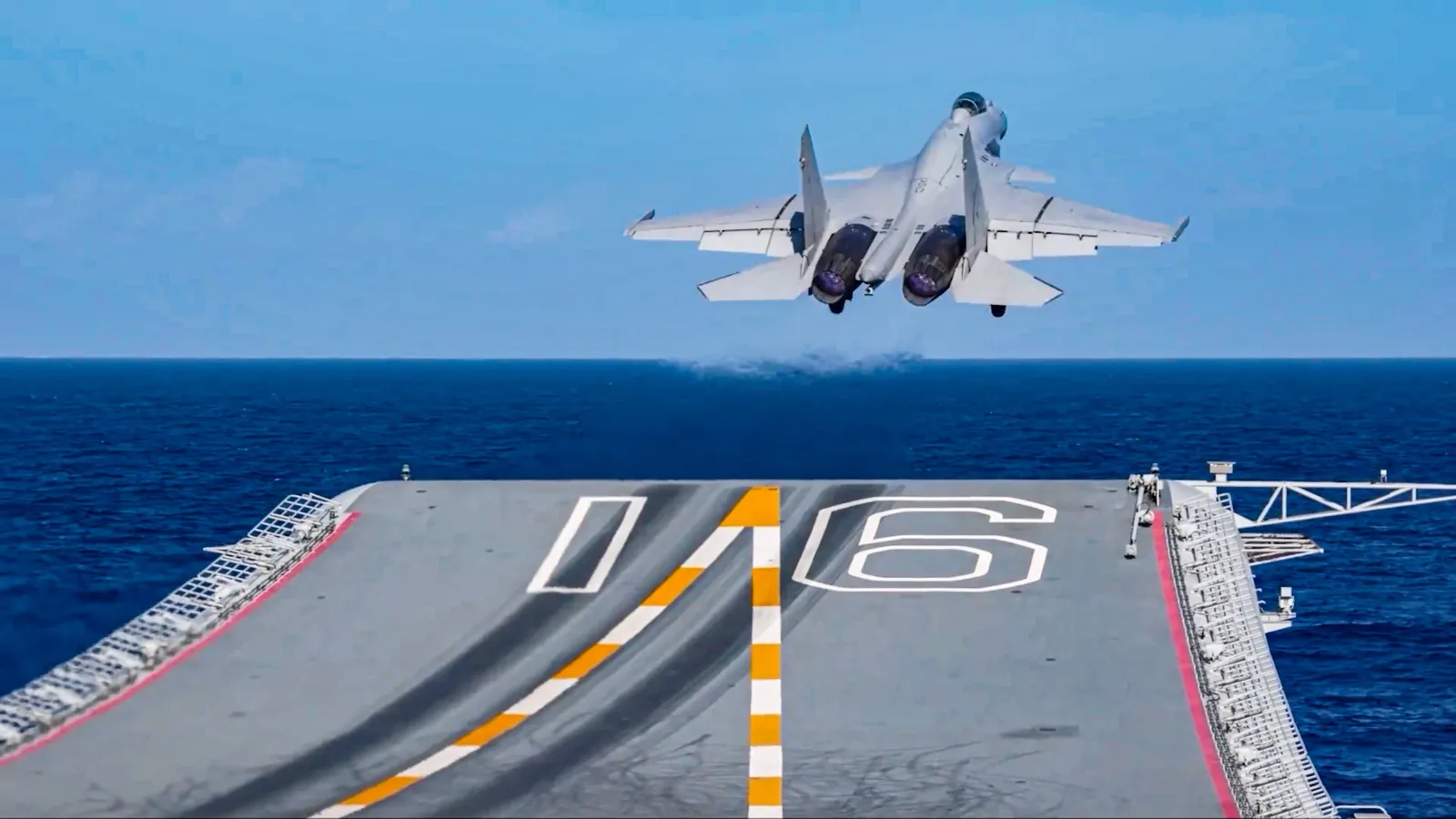
New imagery that surfaced this week shows the upgraded J-15T, the most advanced carrier fighter China builds in series, operating from Liaoning, the oldest and least capable of its three aircraft carriers. That closes the loop: the same aircraft now flies from all three Chinese decks. The detail that matters is that the J-15T was designed around an advanced catapult launch system — the kind fitted to the newest carrier, Fujian. Demonstrating that the same airframe also works from the older ships means China has, in effect, collapsed three separate air-wing problems into one.
The consequences run forward from here, not backward. A single fighter type across every deck means one training pipeline, one spares chain, one maintenance ecosystem. Pilots and aircraft can move between hulls as schedules demand. When one carrier goes into refit, its air wing does not go idle; it redeploys. Analysts assessing the development have framed it exactly this way: cross-deck compatibility is what determines how fast a navy can generate carrier airpower, and China has just raised its ceiling.
What comes next for China
Expect the working-up of Fujian to accelerate, because the fighters qualifying on it are no longer bespoke to that ship. Expect, too, more mixing and rotation of aircraft across the three carriers as China treats its naval fighter fleet as a common pool rather than three separate inventories. And whatever fighter China fields next will inherit this template — commonality across every deck will now be the baseline requirement, not the aspiration. The likely trajectory over the next few years is a Chinese carrier force measured less by hull count and more by how many sorties it can regenerate across the fleet on any given day.
The bar India now has to clear
For India, the timeline pressure is direct. Its two carriers, including the indigenously built INS Vikrant, fly from ski-jump decks, and its carrier aviation roadmap is mid-transition: new Western-built naval fighters being inducted, an indigenous deck-based fighter still in development, and long-running deliberations over what a future third carrier should look like. Each of those decisions now has a benchmark sitting across the Indian Ocean’s eastern approaches: an adversary air wing that is interchangeable across its whole fleet.
The practical questions ahead are unglamorous but decisive. Will India’s next naval fighters be common across both of its decks, or will it run split inventories with split logistics? Will a future carrier commit to catapult launch, and if so, will the aircraft designed for it also work from the existing ships — the exact flexibility China has just demonstrated? These are choices about pipelines and compatibility, not headline platforms.
China’s announcement is not, by itself, a change in the military balance. It is a change in the rate at which that balance can shift. The race India is now in is not to match hulls — it is to match the speed at which airpower can be regenerated at sea. That race has a clock on it, and it started this week.
Sources
- 1. Upgraded J-15T operates from all three Chinese aircraft carriers — interestingengineering.com
- 2. Analysis: why cross-carrier compatibility of advanced fighters matters for the PLAN — scmp.com
Senapathi Desk
Staff reports & analysis
The Senapathi Report news desk. Original reporting and analysis synthesised from multiple corroborated sources — defence procurement, service developments and regional security, filed as it happens.