Modi-Takaichi Summit Yields First Defence Co-Development Pact, Economic Security Roadmap
At their 16th annual summit in New Delhi, India and Japan unveiled their first-ever defence co-development project, a joint economic security declaration and a ¥10 trillion investment target — deepening the Indo-Pacific's democratic axis.

Senapathi Desk
Staff reports & analysis
Published
3 min read
Naval antennas do not usually headline summits. Yet the most consequential line in the long list of agreements India and Japan unveiled in New Delhi on 2 July may be the least glamorous: for the first time in the history of their partnership, the two countries will build a piece of military hardware together. The UNICORN antenna — an integrated mast system for warships — is a modest platform on which to hang two decades of strategic courtship. It is also precisely the kind of unshowy industrial commitment that marks a relationship moving from communiqués to production lines.
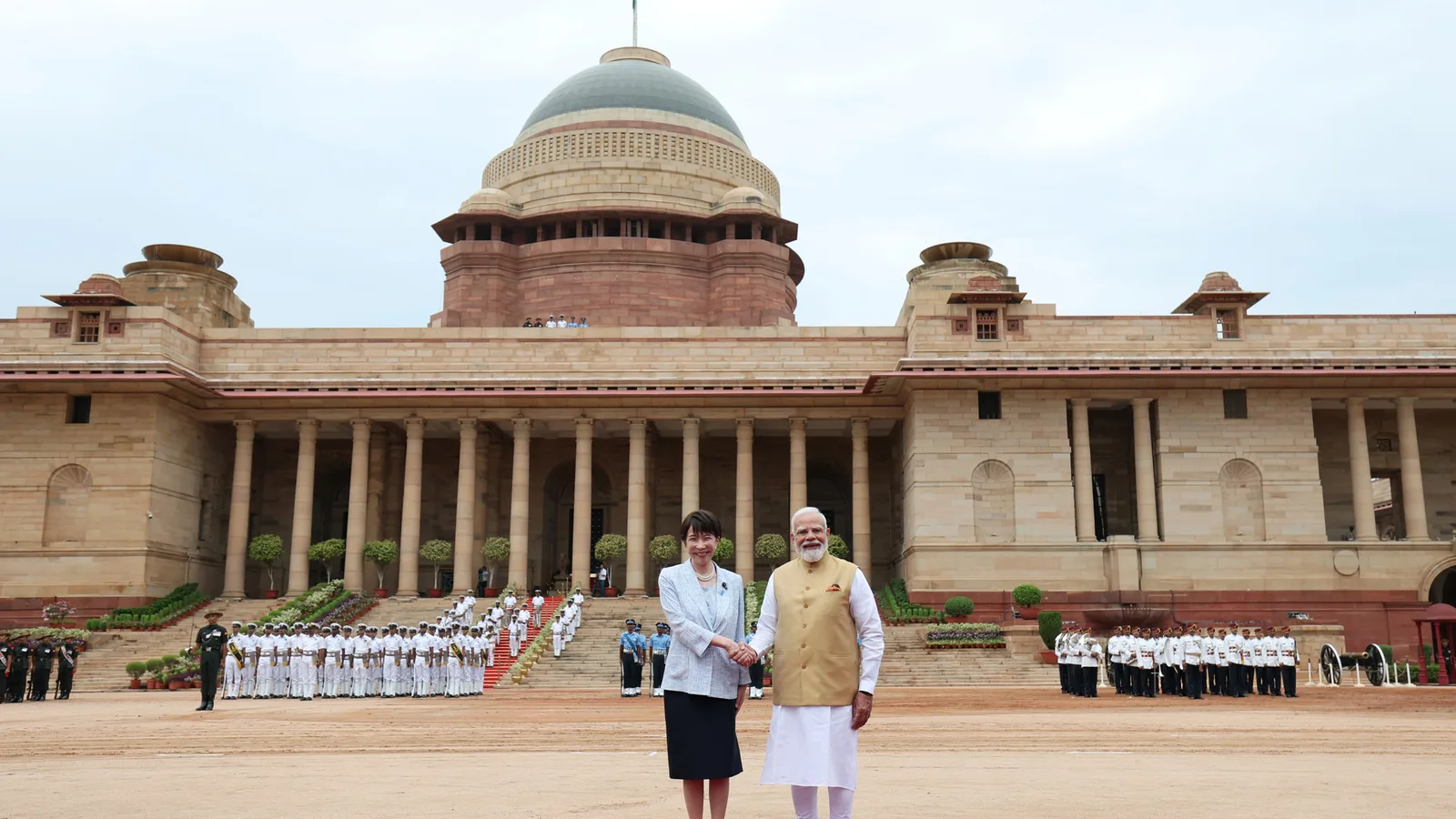
The announcement anchored the 16th India-Japan annual summit, at which Prime Minister Narendra Modi hosted his Japanese counterpart Sanae Takaichi on Thursday. It was Takaichi’s first official visit to India since she took office, and both governments treated it as considerably more than ceremony. The two sides exchanged agreements spanning defence, artificial intelligence, critical minerals, energy security and pharmaceuticals, and capped the talks with a joint declaration on economic security cooperation alongside the defence pact.
From Buyer and Seller to Co-Developers
The UNICORN project matters less for what it is than for what it breaks. India and Japan have circled defence-industrial cooperation for years without ever converting goodwill into a joint programme; every previous summit produced dialogue mechanisms and exercises rather than hardware. Co-development is a different order of commitment. It binds the two defence establishments together at the level of engineers, shipyards and supply chains, and it creates a template that future, larger projects can follow. For Japan, whose defence industry has only cautiously begun looking outward, India offers scale; for India, Japan offers precision naval technology from a partner with no history of leverage over its defence supply.
The pact also sits inside a wider security logic that both leaders were explicit about. The two sides agreed to prepare a joint roadmap for economic security cooperation — a phrase that has migrated from academic journals to summit declarations as democracies confront how much of their industrial base depends on supply chains they do not control. Critical minerals, semiconductors’ feedstocks and AI capability now sit alongside warships in the strategic ledger, and the New Delhi agreements treat them that way.
The Money Behind the Handshake
The economic package was substantial. Japan pledged more than $10 billion in new investments, and the two governments set a ¥10 trillion target for Japanese investment into India. Against that ambition, the current baseline looks strikingly thin: bilateral trade ran to roughly $27.5 billion in the 2025/26 fiscal year, a figure out of proportion to the size of the two economies and to the strategic weight both capitals’ governments now place on the relationship. The investment targets are, in effect, an admission that the commercial relationship has lagged the political one — and a bet that it can catch up.
Some of the deliverables reached well past high technology. Among the announcements was a plan for 1,000 bio-gas and organic fertilizer plants across India, folding Japanese cooperation into India’s energy transition at the village level rather than only in boardrooms. Pharmaceutical cooperation, another item in the exchanged agreements, points the same way: a partnership being deliberately broadened so that it touches supply chains ordinary citizens depend on, not just defence ministries.
The timing gives the summit weight beyond the bilateral. Quad issues were on Takaichi’s agenda in New Delhi, and the outcomes — a defence co-development precedent, an economic security roadmap, hardened supply-chain cooperation — read as the two most populous democracies of the Indo-Pacific consolidating their axis ahead of the grouping’s next cycle. Neither government framed the agreements against any third country, but the architecture speaks for itself: resilience, redundancy and co-production among partners who trust each other.
The test, as ever, is execution. Roadmaps must become documents, investment targets must become factories, and a first co-development project must survive the grind of two procurement bureaucracies. Those are measured in years, not news cycles. But the direction set on 2 July is unambiguous. India and Japan have stopped describing what their partnership could be and started building it — starting, fittingly, with an antenna designed to help ships see further.
Sources
- 1. India, Japan sign pacts on AI, metals and energy cooperation — reuters.com
- 2. India, Japan unveil first defence co-development pact — asia.nikkei.com
- 3. Modi-Takaichi talks produce economic security roadmap and defence pact — indianexpress.com
- 4. India and Japan sign AI, defence and energy deals after summit — moderndiplomacy.eu
- 5. 16th India-Japan Annual Summit joint statement — pmindia.gov.in
- 6. Modi and Takaichi deepen bilateral partnership with investment pledges — m.economictimes.com
Senapathi Desk
Staff reports & analysis
The Senapathi Report news desk. Original reporting and analysis synthesised from multiple corroborated sources — defence procurement, service developments and regional security, filed as it happens.