China Fires an SLBM Into the Open Pacific for the First Time Since 1982
A PLA ballistic missile submarine fired a JL-2 or JL-3 roughly 7,300 km from the South China Sea into the South Pacific on 6 July — China's first announced SLBM test since 1982, and a new benchmark for India's own sea-based deterrent.

Senapathi Desk
Staff reports & analysis
Published
3 min read
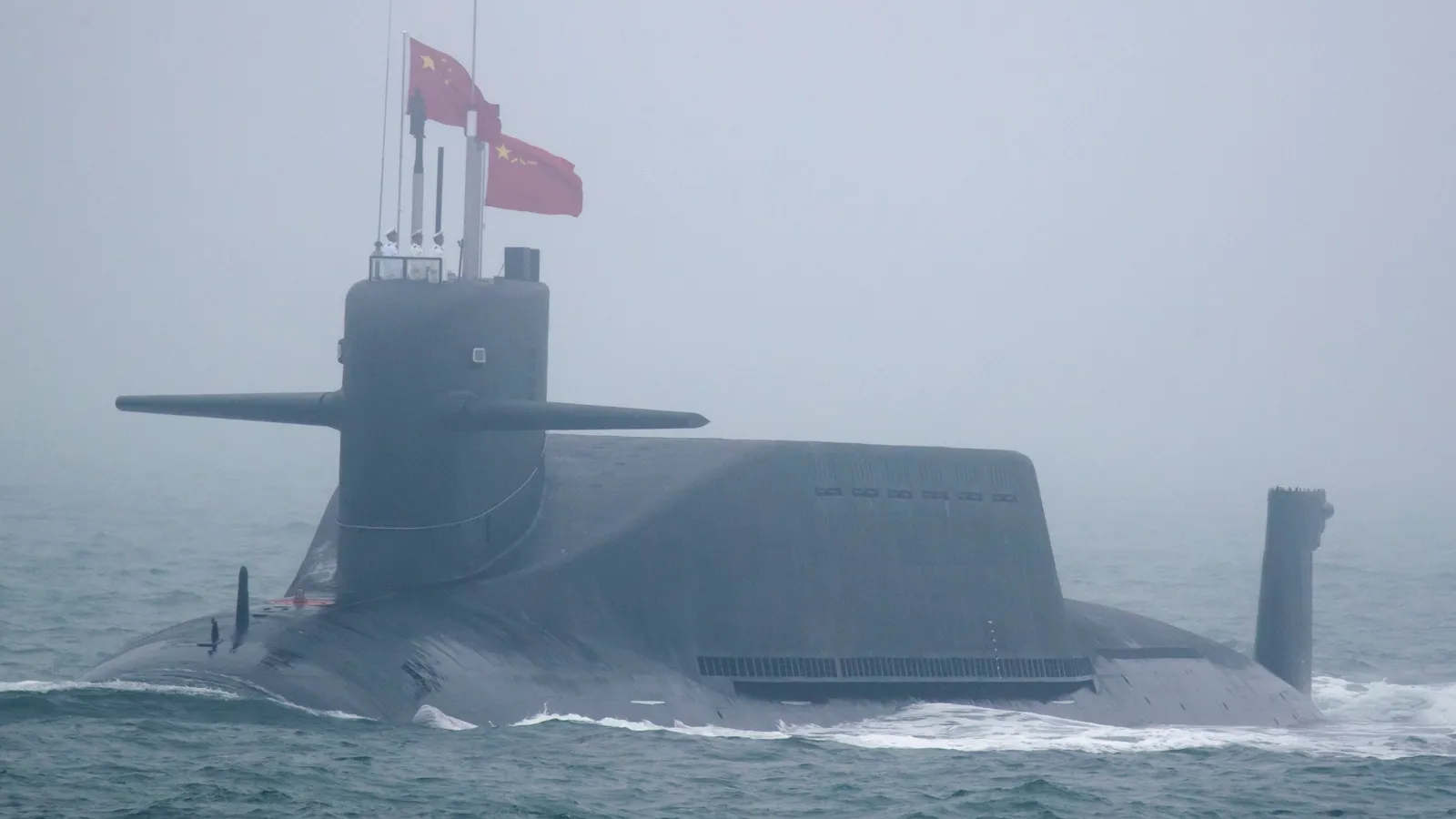
At 4:01 AM UTC on 6 July, a Chinese nuclear-powered ballistic missile submarine sitting in the South China Sea fired a missile that flew roughly 7,300 kilometres — past Luzon, over the exclusive economic zones of Micronesia, Nauru, Kiribati and Tuvalu — before its simulated training warhead splashed down in the South Pacific, between Tuvalu and the Gilbert Islands of Kiribati. It was China’s first publicly announced submarine-launched ballistic missile test since 1982, and the first time China has ever fired an SLBM into international open waters. Forty-four years of testing behind closed doors ended in a single arc across the Pacific.
Exactly what flew is still contested, and the contest is itself informative. Taiwan’s National Security Council Secretary-General Joseph Wu identified the missile as a JL-2, with a range of about 8,000 kilometres, and published a graphic tracing its path from the South China Sea past Luzon into the open ocean. Chinese commentators and a number of outside analysts assess it was more likely the newer JL-3, credited with a range beyond 10,000 kilometres. The launch platform was an unspecified nuclear-powered ballistic missile submarine, probably a Type 09IV. Either reading leaves the essential fact intact: a Chinese submarine demonstrated, in public and at strategic range, the ability to deliver a nuclear-capable missile across the Pacific.
The demonstration was the point. A PLA statement carried by Chinese state media called the launch “a routine part of China’s annual military training program” and said “relevant countries had been notified in advance”. Nothing about it was routine. It came the same day China’s annual naval exercise with Russia began, and it follows the 2024 launch of an intercontinental ballistic missile into the Pacific — two consecutive strategic launches into open ocean in as many test cycles. The pattern suggests a deliberate change of posture: China is progressively unveiling parts of its nuclear deterrent it once kept hidden, and the sea leg — the hardest to build and the hardest to verify — is now being shown rather than merely inferred. This is the first time China has publicly demonstrated a strategic nuclear strike capability launched from a nuclear-powered submarine in the Indo-Pacific.
The geography of the shot carried its own friction. The missile passed near the Philippines and over the economic zones of four Pacific island states, and it landed inside the South Pacific Nuclear Free Zone established in 1986 by the Treaty of Rarotonga — a detail confirmed by New Zealand Foreign Minister Winston Peters. The United States, Japan, Australia and New Zealand all pushed back immediately. China’s claim of advance notification, meanwhile, points at the deeper institutional gap: there is a growing analytical case that launches of this kind demand a formal ballistic missile launch notification agreement with China, rather than ad hoc assurances delivered after the fact.
The Measure for the Arihants
For India, the test is best read as a benchmark. A sea-based deterrent earns credibility not from hull launches and short-range proofs but from exactly what China just displayed: a submerged nuclear-powered submarine, a strategic missile flown to meaningful range over open ocean, and a state willing to announce it and absorb the diplomatic cost. India’s Arihant-class boats and the K-family missiles they carry constitute the newest and least visible leg of its triad, and their development has proceeded with the same opacity China maintained for four decades. The 6 July launch shows where that road eventually leads — and what full demonstration requires. Open-ocean test corridors, overflight diplomacy, advance notification of states downrange: these are capabilities in their own right, and China has now exercised all of them in public. Until India’s sea leg is demonstrated at comparable reach, the gap between the two programmes will be measured not only in missile range but in what each country has been willing to show.
What to watch from here is cadence. One announced launch after 44 years is a signal; a second within a year or two would be a policy. China has decided its underwater deterrent persuades no one while it stays underwater. The next interval will not be another four decades.
Sources
- 1. China test-fires submarine-launched ballistic missile into the Pacific — cnn.com
- 2. China's SLBM test underscores the importance of launch notification agreements — csis.org
- 3. China tests SLBM as annual exercise with Russia begins — news.usni.org
- 4. China's submarine-launched ballistic missile test in the Pacific — armyrecognition.com
- 5. China test-fires long-range missile into Pacific, rattling allies — washingtonpost.com
- 6. Why China's Pacific SLBM test is a big deal — twz.com
Senapathi Desk
Staff reports & analysis
The Senapathi Report news desk. Original reporting and analysis synthesised from multiple corroborated sources — defence procurement, service developments and regional security, filed as it happens.