
Strategic Forces Command Test-Fires Nuclear-Capable Agni-4 in User Trial from Chandipur
India's Strategic Forces Command test-fired the 4,000-km-range, nuclear-capable Agni-4 from Chandipur on 6 August, with the Ministry of Defence saying the launch validated all operational and technical parameters.

Senapathi Desk
Staff reports & analysis
Published
2 min read
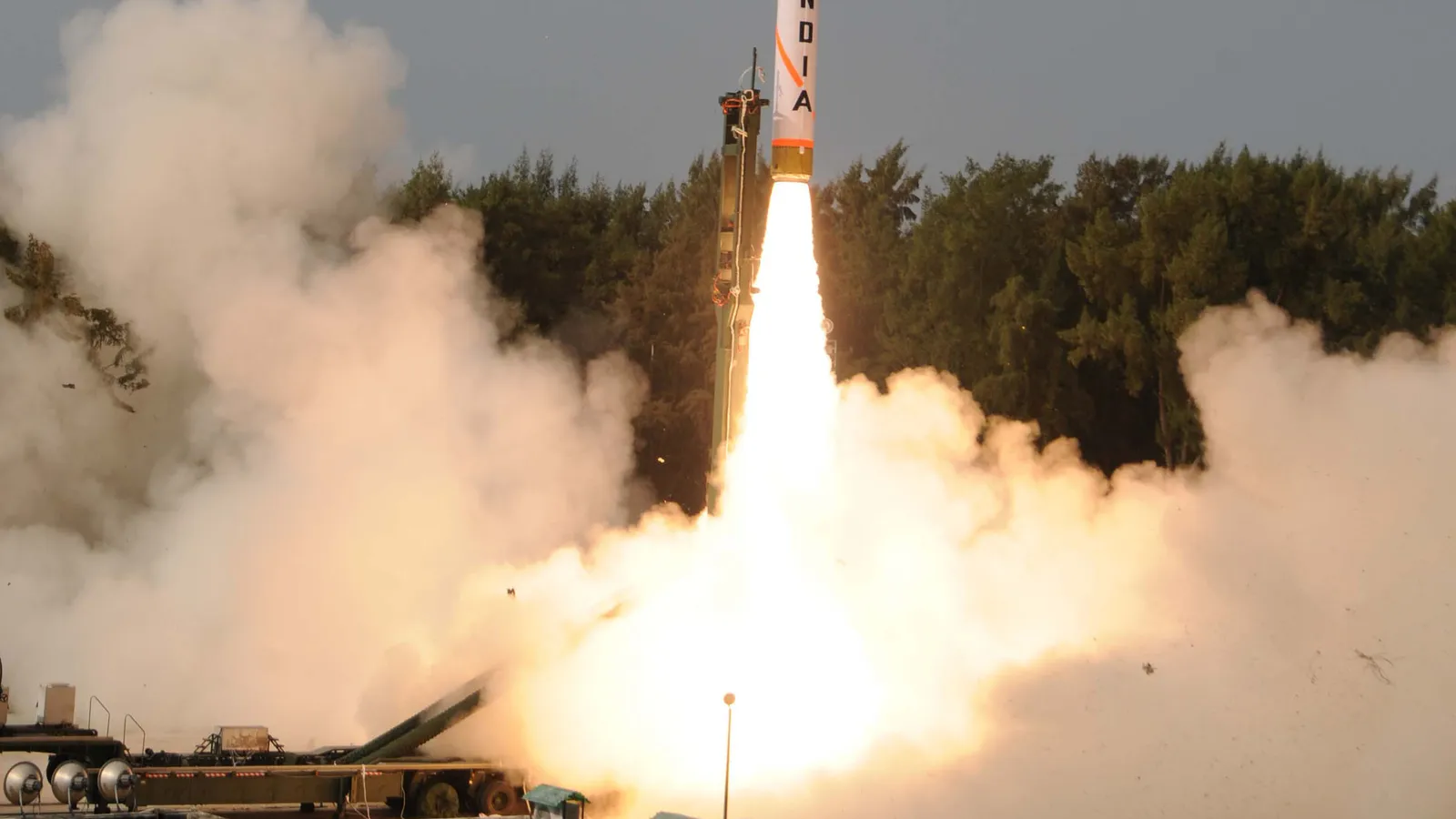
India’s Strategic Forces Command test-fired the Agni-4 medium range ballistic missile from the Integrated Test Range at Chandipur, on the Odisha coast, on 6 August, with the Ministry of Defence confirming that the successful launch validated all operational and technical parameters of the nuclear-capable system.
The firing was carried out under the aegis of the Strategic Forces Command, the tri-service organisation that holds and operates India’s nuclear delivery systems. That detail is the story: a launch conducted by the user command, rather than a developmental trial run by the missile’s designers, is a readiness exercise. It puts the crews, drills and hardware that would execute a real launch order through the complete firing sequence, and the ministry’s statement that every operational and technical parameter was met is precisely what such a test exists to demonstrate.
Agni-4 is a two-stage, solid-fuel missile about 20 metres long, with a strike range of around 4,000 kilometres and a payload capacity of roughly 1,000 kilograms. It is fired from a road-mobile launcher, which lets the system disperse and relocate rather than sit at fixed, targetable sites, while solid propellant allows the missile to be held ready and launched at short notice. The weapon can carry conventional as well as nuclear warheads, and with its roughly 4,000-kilometre reach it occupies the medium-range band of the land-based leg of India’s nuclear triad, complementing the air- and sea-based components of the deterrent.
Defence Minister Rajnath Singh congratulated the Strategic Forces Command and the Defence Research and Development Organisation after the launch. DRDO, which developed the Agni series of ballistic missiles, was reported to have been involved in the test, a reminder that even user trials of a fielded system draw on the organisation that designed it.
The launch did not come unannounced. India had earlier issued a notice to airmen covering a 2,530-kilometre corridor over the Indian Ocean for a missile test window spanning 6 and 7 August, a routine safety measure that clears air traffic from the flight path and, in practice, signals an impending trial to observers who track such notifications. The firing on 6 August fell on the first day of that window.
For the Strategic Forces Command, the value of the exercise lies less in proving the missile than in proving everything around it: the launcher, the procedures and the people who would be ordered to act under conditions no drill can fully replicate. A deterrent works only so long as an adversary believes the weapon will perform when called upon, and periodic user firings that validate every parameter are how that assurance is kept current. On the ministry’s account, the Chandipur launch did exactly that, keeping a core element of the land-based arsenal visibly ready for the role it was built to serve.
Sources
- 1. India successfully test-fires Agni-4 from Chandipur — indiatvnews.com
- 2. India test-fires nuclear-capable Agni-4 missile — gktoday.in
- 3. DD News announcement of the Agni-4 launch — x.com
- 4. Agni-4 test seals strategic deterrence and combat readiness — organiser.org
- 5. India issues 2,530-km NOTAM ahead of missile test window — indiandefensenews.in
Senapathi Desk
Staff reports & analysis
The Senapathi Report news desk. Original reporting and analysis synthesised from multiple corroborated sources — defence procurement, service developments and regional security, filed as it happens.