
HAL and Safran Sign the Aravalli Engine Deal That Unlocks India's 13-Tonne IMRH
The SAFHAL contract turns a 2023 joint venture into a funded programme for a 3,500–4,000 shp turboshaft, India's first co-developed engine of this class, and clears the way for the ₹13,500 crore IMRH design case to reach the CCS.

Senapathi Desk
Staff reports & analysis
Published
3 min read
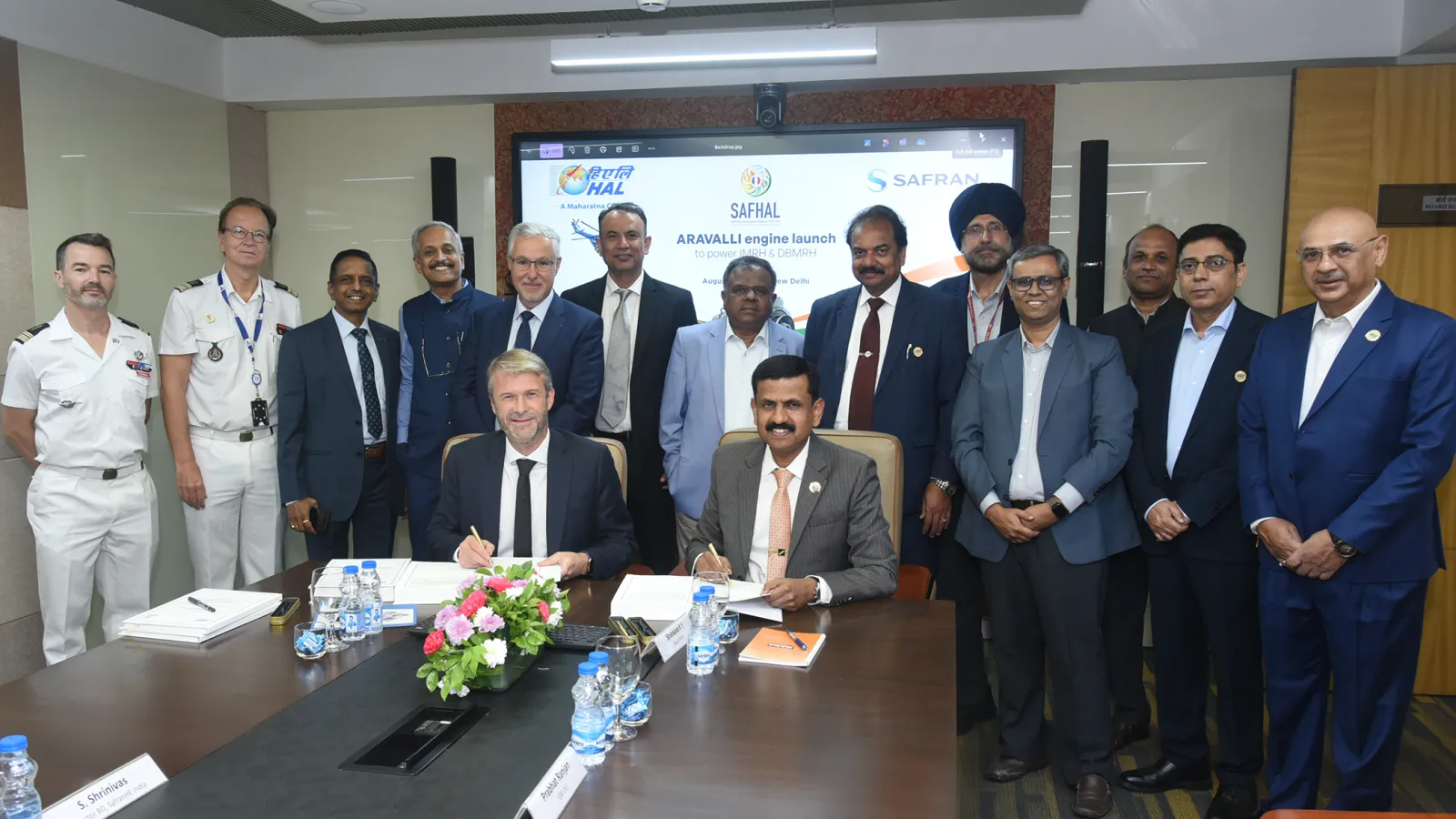
Every helicopter India has built has eventually run into the same wall: the engine. The airframes came, from the Dhruv onward, but the turboshafts that turned their rotors were bought or licensed, never owned. On 26 August that pattern acquired its first serious exception. With the chief executives of both companies looking on, Hindustan Aeronautics Limited and Safran Helicopter Engines put their names to the final contract with SAFHAL Helicopter Engines, their joint venture, to design, develop, manufacture, supply and support through its life a new engine called Aravalli.
The name is borrowed from the old mountain range that runs across western India, and the ambition is scaled to match. Aravalli is a new-generation turboshaft in the 3,500 to 4,000 shaft-horsepower class, the band of power that separates medium-lift helicopters from everything below them. It has been selected to power HAL’s 13-tonne Indian Multi-Role Helicopter, the machine meant to replace the Mi-17 fleet across the armed forces, and the 12.5-tonne Deck-Based Multi-Role Helicopter, the naval variant intended for ship-borne operations.
What was signed
The contract was signed by Ajay Kumar Shrivastava, HAL’s Director of Engineering and R&D, and Olivier Savin, a director of SAFHAL who also serves as executive vice-president for sales and marketing at Safran Helicopter Engines. HAL chairman and managing director K. Ravi and Safran Helicopter Engines chief executive Cédric Goubet witnessed the signing. The joint venture itself is a 50:50 company set up in India in 2023. Until this contract it was a structure with a purpose; now it is a programme with a scope.
That scope matters more than the ceremony. “Design, development, manufacture, supply and lifecycle support” is the full arc of an engine’s existence, and Goubet said it is the first time Safran Helicopter Engines has taken up an engine of this class as a co-development. Manufacturing is planned at Tumakuru in Karnataka, where HAL already has a helicopter plant, and the development timeline runs to 2032-33. The partners did not disclose the contract value, the intellectual-property terms or the delivery schedule, and those omissions are worth remembering when the programme is judged later.
Why the engine comes first
The order of events is deliberate. A 13-tonne helicopter cannot be sanctioned without a credible engine, and Aravalli is the piece that makes the IMRH design case answerable.
Reporting this week, citing television coverage of the file’s movement, indicates that the Cabinet Committee on Security is likely to take up the IMRH design-and-development case at about ₹13,500 crore. The requirement behind it is roughly 350 helicopters across the services over two decades, a fleet-scale replacement of the Mi-17 that would run for a generation. HAL is reported to be planning about ₹12,000 crore of manufacturing investment by 2030 to be ready for that volume.
Set the figures beside each other and the logic of the August signing becomes plain. A ₹13,500 crore development programme for the airframe, a ₹12,000 crore production build-out, and a fleet of 350 aircraft with a lifetime of overhauls ahead of them: the engine is not a component of that plan, it is the plan’s precondition. Without Aravalli the IMRH would be one more Indian airframe on an imported powerplant, with every decision about pricing, spares and upgrades taken somewhere else.
The harder part is ahead
A signed contract is a beginning, not a result. The 2032-33 horizon puts a production-standard Aravalli the better part of a decade away, and helicopter engine programmes are unforgiving of optimism. The undisclosed terms on shareholding of the work, intellectual property and delivery milestones are precisely the terms that will decide whether “co-development” means Indian engineers designing a hot section or Indian technicians assembling one.
What has changed is narrower but real. For the first time, the engine at the heart of an Indian medium helicopter is being designed inside a venture that HAL half-owns, on Indian soil, for an Indian requirement large enough to justify the effort. The Mi-17 fleet has been the workhorse of the services for decades. If HAL and Safran hold to their timeline, its replacement will be the first Indian helicopter whose engine was never a wall to run into.
Sources
- 1. Safran: HAL and Safran Helicopter Engines sign final contract with SAFHAL, launching development and production of the Aravalli engine — safran-group.com
- 2. Bharat Shakti: HAL, Safran sign contract to develop 3,500–4,000 shp Aravalli helicopter engines — bharatshakti.in
- 3. idrw: IMRH programme likely to be taken up for CCS sanction — idrw.org
- 4. idrw: HAL, Safran sign contract to develop Aravalli helicopter engine — idrw.org
- 5. ANI: HAL, Safran Helicopter Engines sign final contract with SAFHAL to launch development, production of Aravalli engine — aninews.in
- 6. Business Standard: HAL, Safran sign contract to develop helicopter engines for armed forces — business-standard.com
Senapathi Desk
Staff reports & analysis
The Senapathi Report news desk. Original reporting and analysis synthesised from multiple corroborated sources — defence procurement, service developments and regional security, filed as it happens.